Human Skills
Ecosystems and the Turning Year
How land, water, plants and animals fit together
6 minAdvancedUpdated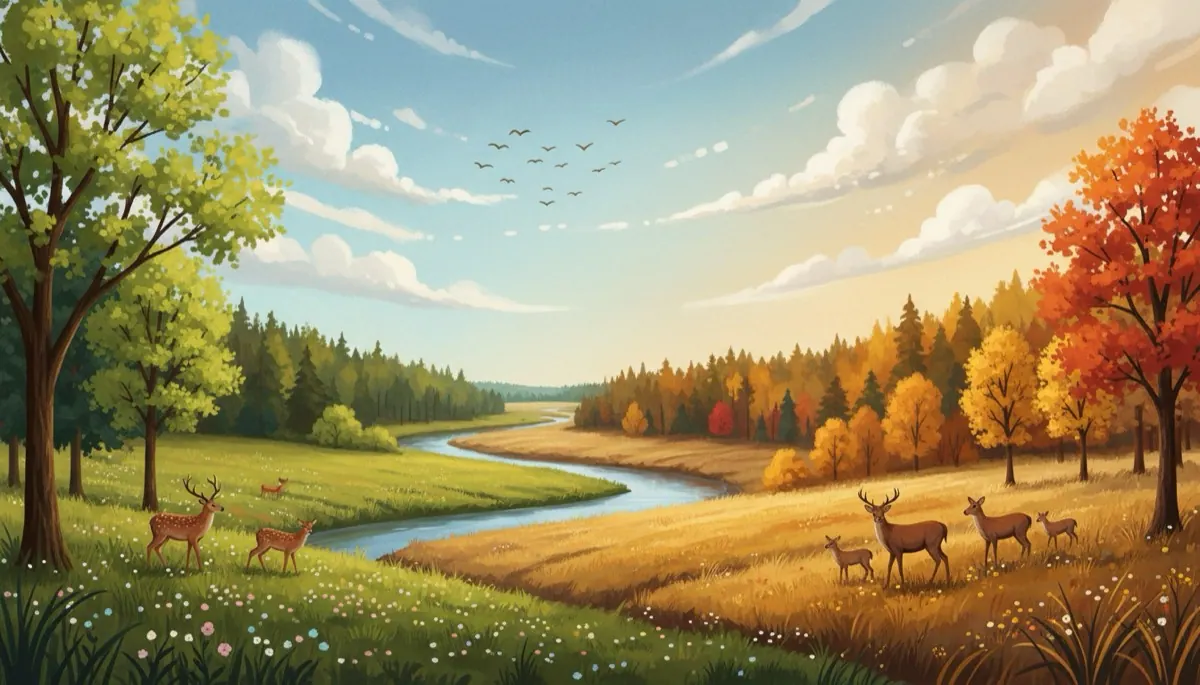
- Read a landscape as a set of connected habitats
- Predict what grows and moves where, month by month
- Use ecosystem thinking to forage, garden and walk with less harm
Everything eats something
An ecosystem is a web of who feeds whom, sitting on soil, water and sunlight. Plants capture sunlight. Herbivores eat plants: caterpillars, rabbits, deer. Predators eat them: birds, foxes, wolves. Decomposers, above all fungi, break everything back into soil. Remove a link and the web shifts. Wolves gone means deer boom and young trees vanish. Hedges gone means no insects, so no birds, so more pests on the crops. Most of the useful things a forager, gardener or walker sees are signs of these links: a nettle bed says nitrogen, a wildflower meadow says nobody sprayed, a lichen-covered branch says clean air, a stream with mayflies says clean water.
Habitats and edges
Learn to see a landscape as habitats: woodland, its edge, grassland, scrub, wetland, riverbank, dune, rocky slope, farmed field. Each has its own plants and animals. Edges, where two habitats meet, are the richest ground: the hedge between wood and field holds species from both plus a few of its own, and that is where blackberries, hazel, sloes, rose hips, nesting birds and most tracks are found. Wetlands hold the most wildlife per square metre and are the most fragile. Mediterranean scrub (matos) of cistus, heather and strawberry tree looks scruffy but feeds bees, rabbits, partridge and boar. Foragers work edges; walkers who want to see animals sit at the edge at dawn.
The Mediterranean year runs backwards
Northern Europe has a growing season from April to October and a dead winter. The Mediterranean flips this. Autumn rain in October wakes the land: grass greens, mushrooms fruit under the oaks, chestnuts fall, olives are picked in November and December. Winter is mild and green. Spring, February to May, is the explosion: orchids, cistus, wild asparagus, nesting birds, everything at once. Then summer, June to September, is the dead season: grass turns to straw, streams dry, fire risk peaks, plants shut down and animals move at dawn and dusk. If you learned nature in a northern book, reset your calendar. In Portugal, September is the start of the year, not the end.
Reading the seasons wherever you are
Phenology is the record of what happens when: first swallow, first cuckoo, hazel catkins, first frost, blackberry ripening. Keep those dates in your journal year after year and you will have a calendar tuned to your own valley. It will tell you when to look for mushrooms (about 10 days after the first heavy autumn rain with warm nights), when chestnuts drop (after the first storms of October), when wild asparagus shoots (two weeks after the first warm spring rain), when ticks peak (warm, damp spring days). It will also show you the climate shifting: earlier springs, later autumns, drier summers. Local knowledge is what makes national field guides work.
Fire, water and the human hand
Mediterranean ecosystems evolved with fire and grazing. Cork oak and cistus resprout after burns; the montado of scattered oaks over pasture is a human landscape thousands of years old that supports more species than dense forest. But abandoned land turns to eucalyptus and dense scrub that burns catastrophically, as Portugal saw in 2017. Water is the other lever: a wetland drained is a hundred species gone, a stream with its bank trees left in place is a fish nursery and a flood brake. As someone who gardens, forages or simply walks, you are part of the system. Leave the edges, keep the trees by the water, respect the fire bans, and take a little rather than a lot.
Bring it back to the rule
Understanding ecosystems makes you a better forager for one reason above all: you learn what should be growing where and when, so a plant or mushroom in the wrong place or season becomes a red flag rather than a lucky find. A “chanterelle” in a lawn in June is not a chanterelle. A “wild asparagus” shoot in August is something else. Context is part of identification, and identification is the rule that does not bend. Never eat anything you have not positively identified, in the right habitat, in the right season, confirmed by someone who knows. The land will feed you for a lifetime if you learn it slowly and take it seriously.
Check yourself
Edges like hedges and woodland margins hold species from both habitats plus their own, which is why foragers and trackers work them.
Autumn rain ends the summer dormancy. Grass greens, mushrooms fruit and chestnuts fall. Summer is the dead season.
Phenology tracks the timing of natural events. Over a few years it becomes a local calendar for foraging, planting and walking.
Habitat and season are part of identification. Wrong place or time means it is probably something else. Never eat anything not positively identified.
Try it for real: Map your local ecosystem
- Choose a 1 km walk near home and sketch the habitats you cross: wood, edge, grass, scrub, water, farmland.
- At each edge, note three plants, one animal sign and one thing people have done (hedge, ditch, fence, mowing).
- Start a phenology page in your journal with today's date and three things happening now.
- Mark the fire-risk season and any fire bans for your region and put a reminder in your calendar.
- Repeat the walk in three months and record what changed.
🛒 Gear for this skill
As an Amazon Associate I earn from qualifying purchases. It costs you nothing extra and keeps this site free.
Written and checked by the Human Skills team against the sources below. How we check our content
- FAO Forest Resources Assessment
- ICNF Instituto da Conservação da Natureza e das Florestas
- Leave No Trace Center for Outdoor Ethics