Human Skills
How to Look at a Plant
Leaf shape, arrangement, flowers and habitat
5 minBeginnerUpdated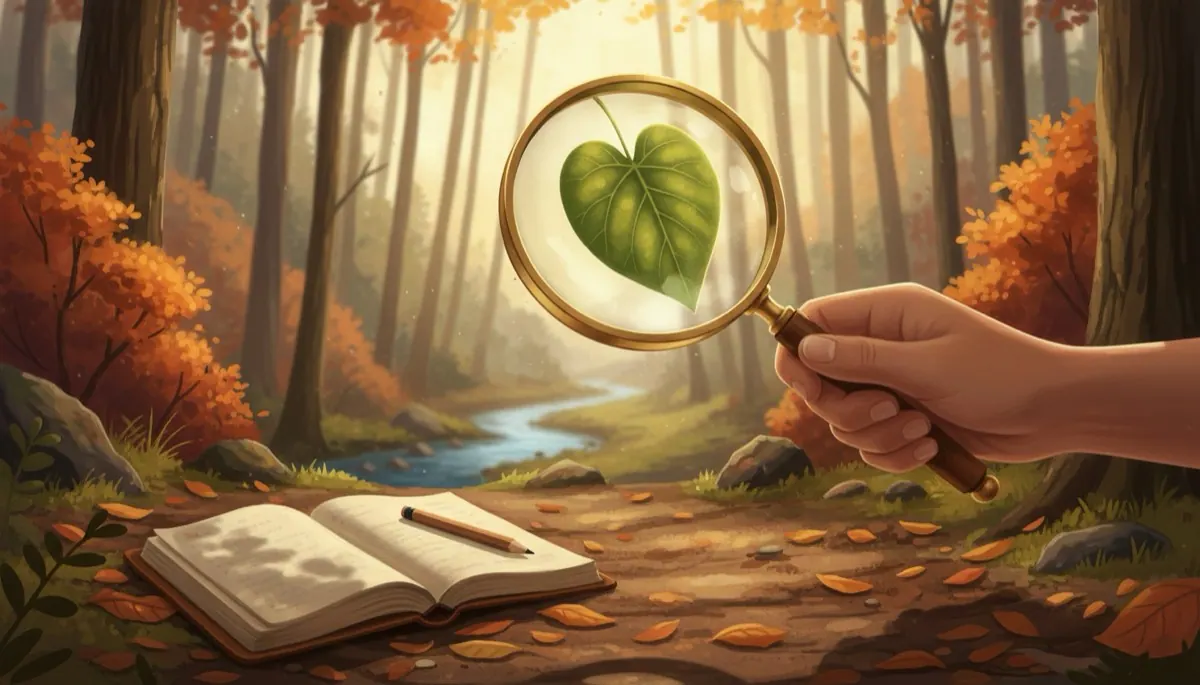
- Describe a leaf by shape, edge and arrangement
- Count flower parts and note the habitat
- Keep a simple plant journal that improves every week
Identification is a habit, not a talent
Most people walk past hundreds of plants and see “green”. Botanists see the same plants and read them like street signs. The difference is a set of questions they ask every time. This lesson gives you those questions. You will not learn 500 species this week. You will learn how to look, so that every walk teaches you something. Start with a notebook or the notes app on your phone. Every time you meet a plant that catches your eye, write down five things: where it grows, how tall it is, the leaf, the stem, the flower. Later you compare your notes with a field guide. The notes are what make the guide usable.
Read the leaf
The leaf is the best clue on most plants. Look at four things. Shape: is it a needle, a blade of grass, a heart, an oval, a hand with fingers? Edge: smooth, toothed like a saw, or lobed like an oak? Surface: hairy, glossy, waxy, dull? Veins: one central vein with branches, several veins fanning from the base, or parallel lines like grass? Then decide if it is a simple leaf (one blade) or a compound leaf (several leaflets on one stalk). A compound leaf has a bud at the base of the whole stalk, not at the base of each leaflet. That single test separates an ash tree from a tree with plain oval leaves.
Read the arrangement
How leaves attach to the stem is a fixed rule for each species, which makes it a strong clue. Alternate: leaves come off the stem one at a time, zigzagging up. Opposite: leaves come off in pairs, facing each other. Whorled: three or more leaves circle the stem at the same point. Basal: all leaves sit in a rosette at ground level, like dandelion or plantain. Also look at the stem itself. Round or square? Mint family stems are square, which you can feel by rolling one between your fingers. Hollow or solid? Hairy, smooth or with a grey bloom? Each of these is a small fact that narrows the list.
Read the flower and the fruit
Flowers are the most reliable feature because they change least between plants of the same species. Count the petals: 3, 4, 5 or many. Note the colour and whether the petals are joined into a tube or free. Look at how flowers are grouped: single, in a flat umbrella (umbel), in a spike, in a daisy-like head. Then look for the fruit or seed later in the season: pod, berry, capsule, nut, fluffy parachute. A four-petal flower with a cross shape points to the cabbage family. An umbrella of tiny white flowers points to the carrot family, which contains both parsley and deadly hemlock, so it is a family to respect, not to taste.
Read the habitat
Where a plant grows is a clue and a filter. Wet ditch, dry rocky bank, shaded woodland floor, disturbed roadside, salty dune, mown lawn: each has its own community. Nettles mark rich, nitrogen-heavy soil, often where animals or people have been. Reeds and rushes mean waterlogged ground. Heather and gorse mean acid, poor soil. When a field guide says a plant lives in bogs and you found yours on a dry wall, either the guide is wrong or, far more likely, you have a different plant. Habitat, leaf, stem, arrangement and flower together give you a fingerprint. One clue alone never does. That is the foundation for everything else in this category, especially foraging.
Check yourself
Opposite leaves come off the stem in facing pairs. Alternate leaves zigzag one at a time, whorled leaves circle the stem, basal leaves form a ground rosette.
The mint family (mint, thyme, sage, dead-nettle) is famous for square stems and opposite leaves.
Flowers vary least within a species, which is why field guides are organised around them. Height and colour change with age, soil and weather.
The carrot family contains carrot, parsley and fennel but also poison hemlock and hemlock water-dropwort. Never taste an umbel plant on a guess.
Try it for real: Start a five-plant journal
- Choose five plants near your home, garden or a local park.
- For each, note habitat, height, leaf shape and edge, arrangement, stem shape and flower if present.
- Photograph whole plant, leaf and flower.
- Match each to a field guide or a regional plant society list using your notes, not just the photo.
- Revisit the same five plants in two weeks and add what changed.
🛒 Gear for this skill
As an Amazon Associate I earn from qualifying purchases. It costs you nothing extra and keeps this site free.
Next lesson: Four Plants Everyone Should Know →
Written and checked by the Human Skills team against the sources below. How we check our content
- Royal Horticultural Society (RHS)
- Botanical Society of Britain and Ireland
- Flora-On (Sociedade Portuguesa de Botânica)