Human Skills
Reading Animal Tracks and Signs
Prints, droppings, feeding marks and trails
5 minIntermediateUpdated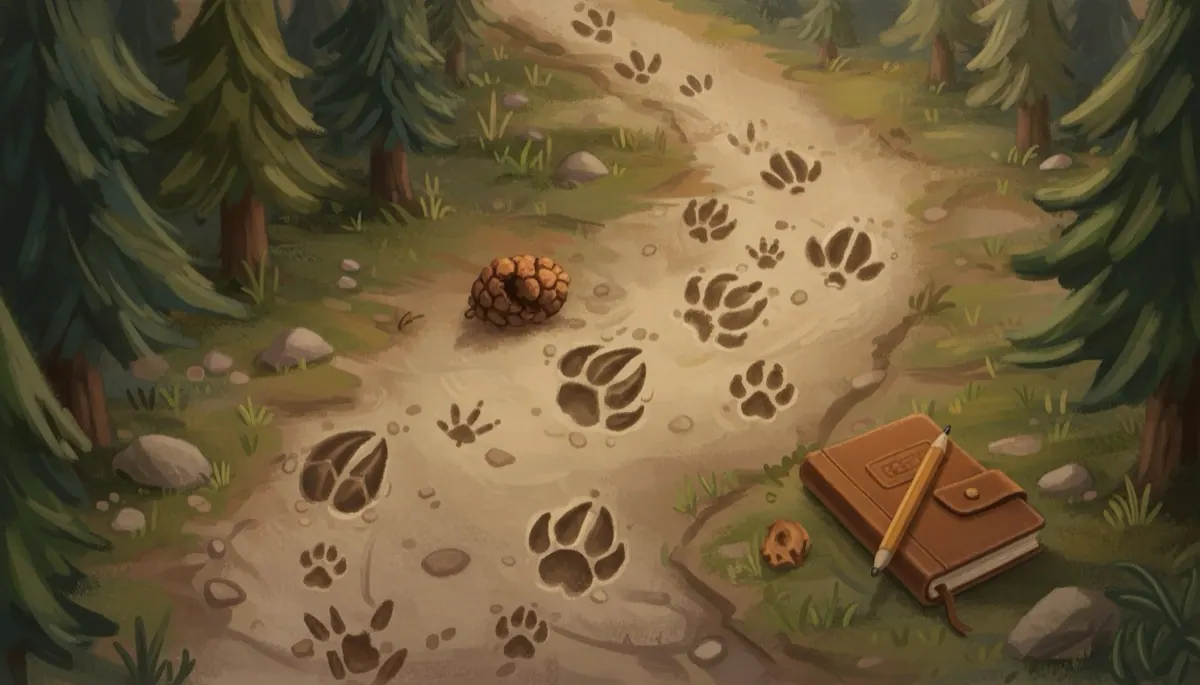
- Tell dog, cat, deer, boar and rabbit prints apart
- Read droppings, feeding signs and paths for the animal behind them
- Find the best places and times to look
Where and when tracks show
Animals leave prints where the ground is soft: mud at a stream edge, wet sand, fresh snow, dust on a farm track after rain, the bare margin of a field gate. The best hours are early morning, when overnight visitors have passed and the sun is low so shadows fill each print. After light rain or a dusting of snow, a path becomes a fresh page. Carry a small ruler or use a coin for scale in photos. Look at a track line from a distance first to see the pattern of the walk, then kneel for detail. A single print tells you a little. A line of ten tells you speed, direction, size and often mood.
Dog, fox, cat and wild cat
Dog and fox prints show four toes and a rear pad with claw marks. A fox print is small (about 5 cm long), neat and narrow, and you can draw an X between the pads without crossing a toe. Dog prints are wider and rounder, and the line of the walk wanders. Fox tracks run in a straight, deliberate line, each rear foot landing in the front print. Cats, domestic or wild, leave four toes and no claw marks, because they retract their claws. A cat print is round and about 3 to 4 cm. Otter prints show five toes and, in mud, webbing, always near water, often with a slide into the river.
Deer, boar, sheep and rabbit
Two-toed prints (cloven hooves) belong to deer, boar, sheep and goats. Roe deer prints are slim, pointed and about 4 to 5 cm long, like two teardrops. Red deer are bigger, 7 to 9 cm, and rounder. Wild boar prints are wide and blunt with two extra dew claw marks behind, set wide apart, because boar sink into mud; they are common across Portugal and Spain. Sheep prints are rounder than deer and always in a crowd. Rabbits and hares leave a Y-shaped pattern: two long back feet landing side by side ahead of two small front feet. A hare's leap is over a metre; a rabbit's about 30 to 60 cm.
Droppings, feeding signs and homes
Droppings are honest witnesses. Deer and rabbit leave round pellets: rabbit ones are pea-sized and dry, deer ones larger and pointed at one end, in a heap. Fox droppings are twisted with a pointed tip, full of fur and berry seeds, left on a stone or path as a signpost. Boar leave loose dark heaps. Owl pellets (not droppings) are grey furry lumps of bone under a roost. Feeding signs: hazelnuts gnawed with a neat round hole are wood mouse; split cleanly in half, squirrel; pine cones stripped to the core, squirrel again. Bark rubbed smooth at 60 to 80 cm with mud and hair is a boar scratching post. A tunnel 20 cm wide with a heap of spoil and bedding outside is a badger sett.
Trails, beds and the story
Animals use the same routes for years. A narrow tunnel through long grass 15 cm high is a vole or mouse run; 25 to 30 cm is rabbit; a well-trodden path at knee height through bracken is deer or boar. Hair snagged on a wire fence at 40 cm is badger, at 80 cm deer. A flattened oval in long grass still warm at dawn is a deer bed. Put the clues together and you have a story: a fox came down the track, paused at the gate, turned toward the hen house, and left again the way it came. Reading that story before you walk in tells you what lives on the land and where to place a camera or a fence.
Check yourself
Foxes walk with purpose, placing rear feet into front prints along a straight line. Cat prints show no claws, deer prints are two-toed.
Boar are heavy and sink into soft ground, so the dew claws register wide and behind the main hoof.
Rabbits and hares hop, landing their long back feet ahead of and outside their small front feet.
Squirrels split nuts in two. Wood mice gnaw a neat round hole with tooth marks around the edge.
Try it for real: Read a muddy path
- The morning after rain, walk a muddy track, stream edge or field gate.
- Find at least three different prints. Photograph each with a coin for scale.
- Identify each using toe count, claws, size and the pattern of the walk.
- Look for one non-print sign: droppings, gnawed nuts, a run through grass, a scratching post.
- Write a two-sentence story of what happened on that path overnight.
🛒 Gear for this skill
As an Amazon Associate I earn from qualifying purchases. It costs you nothing extra and keeps this site free.
Next lesson: Wildlife Awareness: Distances, Ticks and Snakes →
Written and checked by the Human Skills team against the sources below. How we check our content
- Mammal Society tracks and signs guides
- Bang and Dahlstrøm, Animal Tracks and Signs
- ICNF Instituto da Conservação da Natureza e das Florestas