Human Skills
Clothing and Textile Repair
Buttons, stitches, patches and darning
5 minIntermediateUpdated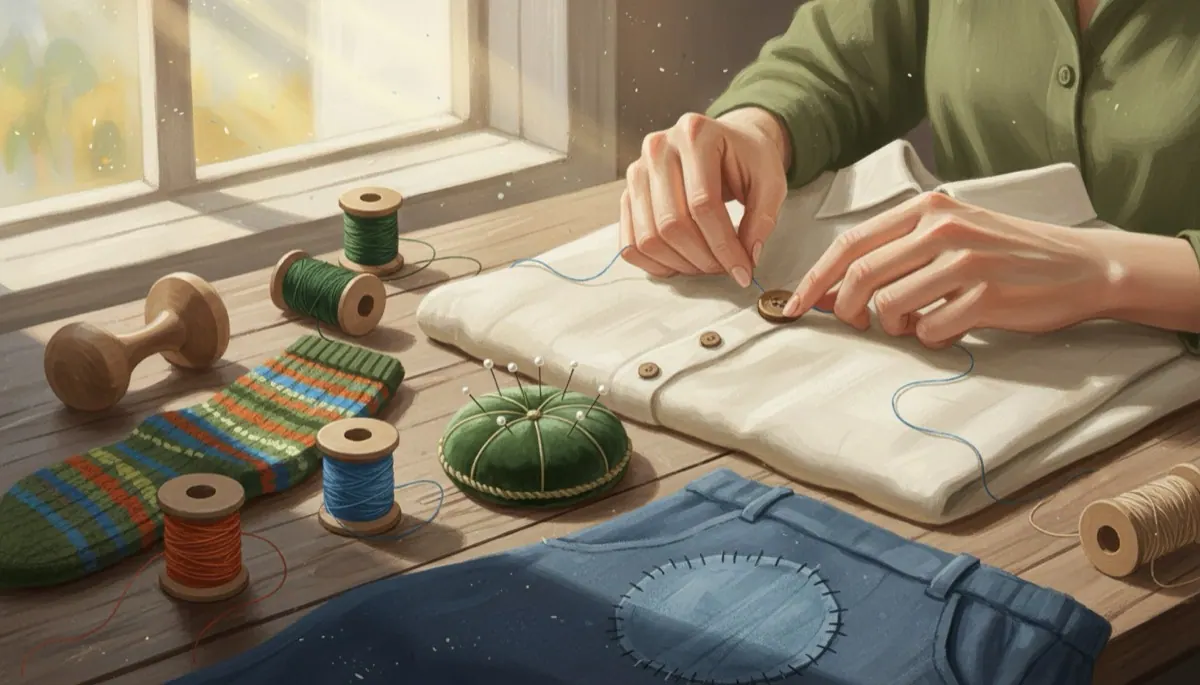
- Sew a button that stays on
- Use running, back and whip stitches for common fixes
- Patch a tear and darn a hole in a sock or jumper
The small kit
A sewing kit that fixes most things fits in a tin: a pack of hand needles in mixed sizes (sharps for fabric, a blunt darning needle for knits), all-purpose polyester thread in black, white and navy, a small pair of sharp scissors, a seam ripper, a few safety pins, a thimble, assorted buttons, and some iron-on and fabric patches. Cut thread about 50 cm long, arm’s length; longer tangles. To thread a needle, cut the thread at an angle, wet the end and push it through. Knot the tail by wrapping it twice round your finger and rolling it off. Match thread colour to the fabric, or go a shade darker.
Sewing a button
Mark the spot with the old thread holes. Bring the needle up from the back, through one hole of the button, and lay a matchstick or toothpick across the top of the button so you sew over it: this creates slack, called a shank, so the button can pass through the buttonhole without straining. Sew through the holes 6 times, in a cross for four-hole buttons or straight for two. Remove the matchstick, lift the button, and wind the thread 4 or 5 times tightly round the threads beneath it to make the shank. Push the needle to the back and finish with three small stitches on top of each other. Cut the thread.
Three stitches that do everything
Running stitch: needle in and out in a straight line, small even stitches, for gathering, tacking and quick repairs where strength is not the point. Back stitch: come up, go back one stitch length, come up one stitch length ahead of the first; each stitch overlaps and the line is as strong as a machine seam. Use it for reopening seams on trousers and shirts. Whip stitch: sew over the edge of the fabric in a spiral, for hems, closing a pillow, and attaching patches. Practise each on a scrap until stitches are 3 to 4 mm and even. Start and end every line with a few stitches on the spot to lock it.
Patching a tear
For a tear in jeans, work jacket or a tent, a patch from the inside is neatest. Cut a patch 2 cm larger than the damage all round, in similar fabric (an old pair of jeans is a lifetime of denim patches). Trim loose threads from the tear, pin the patch behind it, and sew round the tear’s edge with small back stitches or whip stitches, catching the patch. Then sew round the patch’s outer edge to stop it curling. Iron-on patches work for a quick fix but peel after a few washes unless you also stitch the edges. On a knee, use a larger patch than you think; the fabric around a tear is thin too.
Darning a hole
Darning rebuilds fabric by weaving new thread across a hole. It works on socks, jumpers and any knit. Slip a darning mushroom, a tennis ball or a light bulb inside so the fabric is taut. With a blunt darning needle and wool or thick thread, sew a row of running stitches around the hole about 1 cm out, to anchor into sound fabric. Then lay parallel lines across the hole in one direction, going 1 cm into the good fabric each side and leaving the thread slightly loose. Turn 90 degrees and weave over and under those lines. Keep it loose enough to stretch. A visible darn in a contrasting colour is called visible mending and is a style in itself.
Check yourself
The slack under the button, wound into a shank, lets the buttonhole fabric sit beneath without straining the thread.
Back stitch overlaps each stitch, producing a continuous, strong line comparable to a machine seam.
A 2 cm margin gives sound fabric to stitch into; a patch the size of the hole would pull straight out.
Anchoring into strong fabric around the hole gives the woven threads something to hold, otherwise the darn pulls away.
Try it for real: Mend three things this week
- Assemble a small sewing kit and keep it where you dress
- Sew a button onto scrap fabric using the matchstick shank method
- Repair one open seam with back stitch
- Darn a thin heel or patch a small tear on a garment you actually wear
🛒 Gear for this skill
As an Amazon Associate I earn from qualifying purchases. It costs you nothing extra and keeps this site free.
Next lesson: Sanitation Off-Grid →
Written and checked by the Human Skills team against the sources below. How we check our content
- WRAP Love Your Clothes repair guides
- Royal School of Needlework
- Patagonia Worn Wear repair guides