 Human Skills
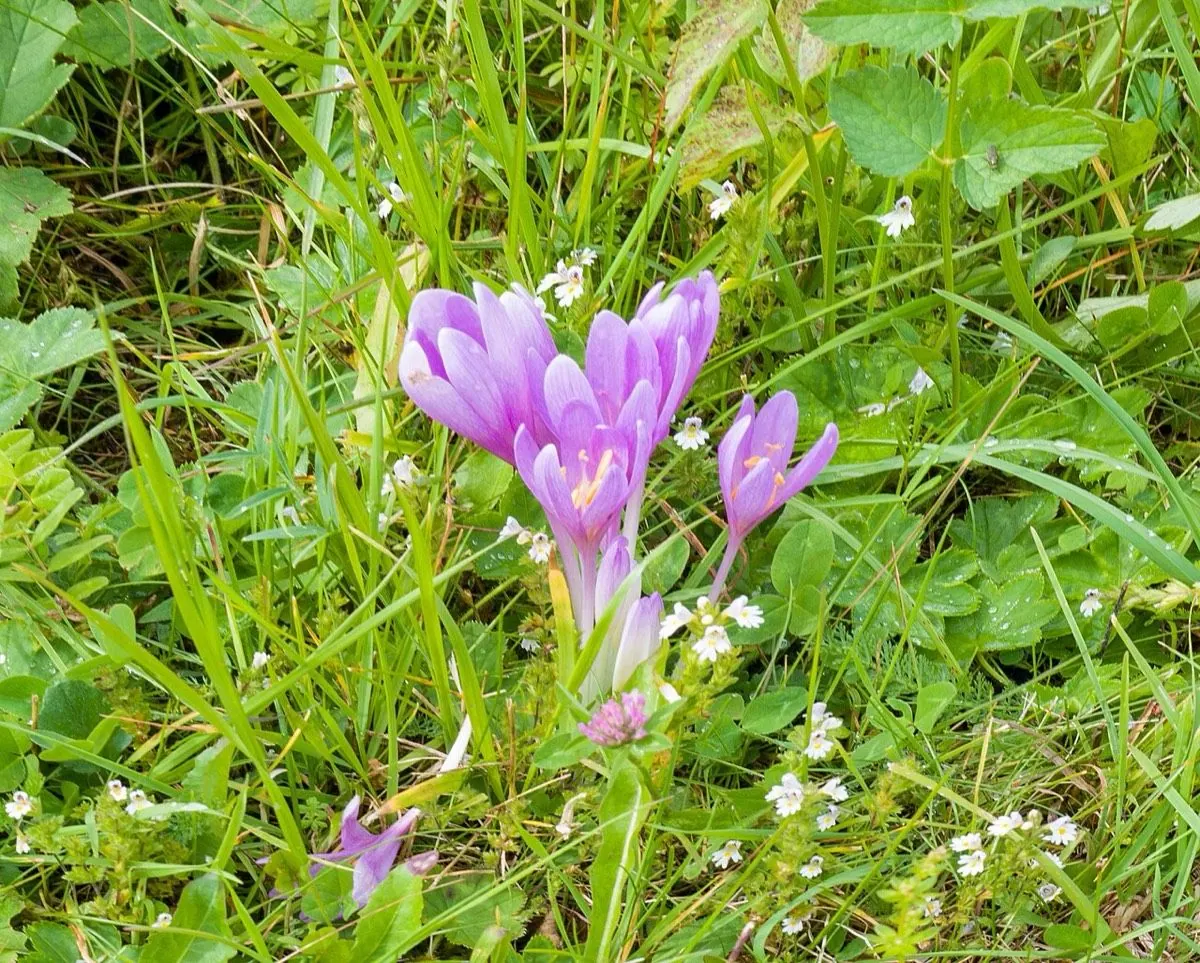
Photo: This Photo was taken by Wolfgang Moroder. Feel free to use my photos, but please mention me as the author and send me a message. This image is not in the public domain. Please respect the copyright protection. It may only be used according to the rules mentioned here. This specifically excludes use in social media, if applicable terms of the licenses listed here not appropriate. Please do not upload an updated image here without consultation with the Author. The author would like to make corrections only at his own source. This ensures that the changes are preserved.Please if you think that any changes should be required, please inform the author.Otherwise you can upload a new image with a new name. Please use one of the templates derivative or extract., CC BY-SA 3.0, Wikimedia Commons

Autumn Crocus
Colchicum autumnale
PoisonousPoisoning like arsenic with no antidote, and the damage is often already done by the time you feel ill.
Confused with
Danger: Colchicine causes burning throat, then vomiting and severe diarrhoea hours later, then organ failure, bone marrow failure and death days afterwards. There is no antidote. Deaths from leaves gathered as wild garlic happen in Europe every spring.
How to tell: Crush and smell. Wild garlic smells powerfully of garlic. Autumn crocus smells of nothing. Then check how the leaves grow: wild garlic leaves come up singly, each on its own thin stalk, and are soft and matt. Autumn crocus leaves come up in a tight bundle of three or more from one point, thick, stiff and glossy. No garlic smell, tight bundle, do not pick.
Danger: One or two leaves among a bag of wild garlic is enough to poison the whole family. Symptoms start two to twelve hours later, so nobody links it to the meal.
How to tell: Smell each leaf as you pick, not the bunch at the end. Garlic smell transfers onto your fingers and masks the test, so use a fresh part of your hand or rub the leaf on the back of your wrist.
Danger: People collect the autumn flowers thinking they are wild saffron and poison themselves with the stamens.
How to tell: Count. Saffron crocus has three stamens and one bright red three-branched style, and its leaves are present with the flower. Autumn crocus has six stamens, a yellow style, and flowers on bare ground with no leaves.
Leaves
Broad, glossy, strap-shaped, 15 to 35 cm long and 2 to 5 cm wide, deep green, rising in a tight clump of three to six directly from the ground in late winter and spring, with no stem and no flower. The seed capsule appears among them in late spring.
Flowers
Pale pink to lilac goblets 4 to 7 cm across with six petals, appearing in autumn out of bare ground with no leaves at all, which is why it is called naked ladies. Six stamens, unlike true saffron crocus which has three and a large red three-branched style.
Stem
No true stem. Flowers and leaves rise separately from an underground corm.
Smell or taste
Almost no smell. No garlic smell from the leaves. Never taste any part, and never assume a saffron-like flower is saffron.
Habitat
Damp meadows, pasture, hay meadows, woodland edges and old gardens, on limestone and heavy soils. Scattered in northern and central Portugal and widespread in central Europe.
Preparation
There is no preparation that makes it safe. Colchicine is not destroyed by cooking, drying, freezing or boiling, and it passes into the milk of animals that graze it. Do not put any part near food.
Traditional use
The source of colchicine, still used as a real medicine for gout and familial Mediterranean fever. That medicine is purified, measured by the milligram and prescribed with monitoring, because the toxic dose is close to the useful one and overdose kills over several days with no antidote. Extracting or dosing this at home is lethal. The medicines derived from it are made under laboratory control.
Harvest rule
Never harvest. Where it grows in hay meadows it must be dug out corm and all before flowering, wearing gloves, and the material bagged rather than composted or fed to stock. Where it is a rare native meadow plant it may be legally protected, so check with your local conservation authority before clearing a wild population, and fence stock out instead.
Colquico, acafrao-bastardo, narciso-do-outono (PT); meadow saffron, naked ladies (EN)