 Human Skills
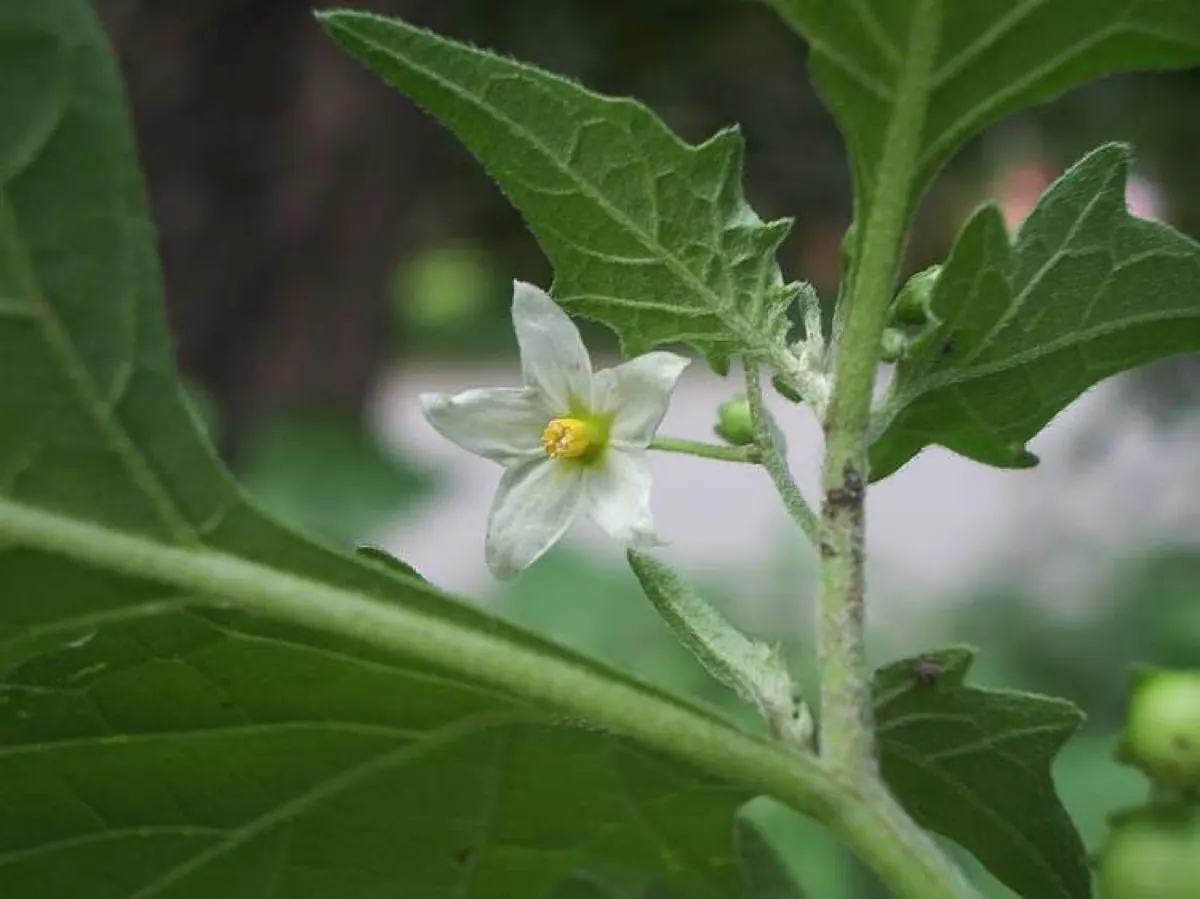
Photo: Harald Hubich, CC BY-SA 3.0, Wikimedia Commons

Black Nightshade
Solanum nigrum
PoisonousA garden weed whose green berries and leaves cause burning, vomiting and collapse, and which this guide tells you to leave alone despite what you may read.
Confused with
Danger: Solanine causes burning of the mouth and throat, stomach pain, vomiting, diarrhoea, headache, and in serious cases a slowed heartbeat, breathing trouble and collapse. Green unripe berries are the most poisonous and children eat them.
How to tell: Black nightshade berries hang in small bunches from a short stalk on the side of the stem, above dull wavy-edged leaves on a weedy annual in cultivated soil. Real wild berries grow on woody bushes. Berries growing on a soft weed in a vegetable bed are not fruit.
Danger: In parts of Africa, Asia and southern Europe the leaves are boiled and eaten, and some strains are far lower in solanine. Elsewhere the same-looking plant has poisoned people. You cannot tell the strains apart by eye.
How to tell: There is no field difference between a low-solanine and a high-solanine population. That is the point. Do not use this plant as a green.
Danger: Mistaking belladonna for this common weed means a far worse poisoning: hallucinations, seizures and possible death.
How to tell: Deadly nightshade berries are large, glossy and solitary in a green star on a tall bushy perennial. Black nightshade berries are small and dull in hanging bunches on a low weed. Size, gloss and bunching separate them.
Leaves
Dull green, oval to diamond-shaped, 3 to 8 cm long, pointed, with a wavy or bluntly toothed edge, thin and slightly hairy. Alternate.
Flowers
Small white star-shaped flowers 5 to 10 mm across with five backswept petals and a cone of bright yellow anthers in the middle, in small drooping clusters of three to eight off the side of the stem, not from the leaf junction. The berries are dull black, 6 to 10 mm, in little hanging bunches.
Stem
Green, sometimes purplish, ridged or angled, branching, slightly hairy, not hollow.
Smell or taste
Crushed foliage smells sharp and rank, like a tomato plant gone wrong. Never taste any part.
Habitat
Vegetable gardens, allotments, arable land, manure heaps, waste ground, orchards and any rich disturbed soil. Extremely common all over Portugal and southern Europe.
Preparation
This guide gives no preparation for it. Long boiling with changes of water reduces solanine in the traditions that use it, but it does not reliably make an unknown plant from an unknown population safe, and green berries stay dangerous whatever you do. Never eat the green berries, cooked or raw.
Traditional use
Cooked leaves are a traditional green in several parts of the world, and it has been used in folk medicine as a poultice for skin complaints. Those uses depend on local strains and on knowledge passed down in person. Do not start from a book or an app.
Harvest rule
Weed it out, do not gather it. Pull it before it fruits, especially in beds children play around and in runs where poultry scratch. Bag the fruiting plants rather than composting them, because the seed survives. Do not feed pulled plants to animals.
Erva-moira, erva-moura, tomatinho-do-diabo (PT); black nightshade (EN)