 Human Skills
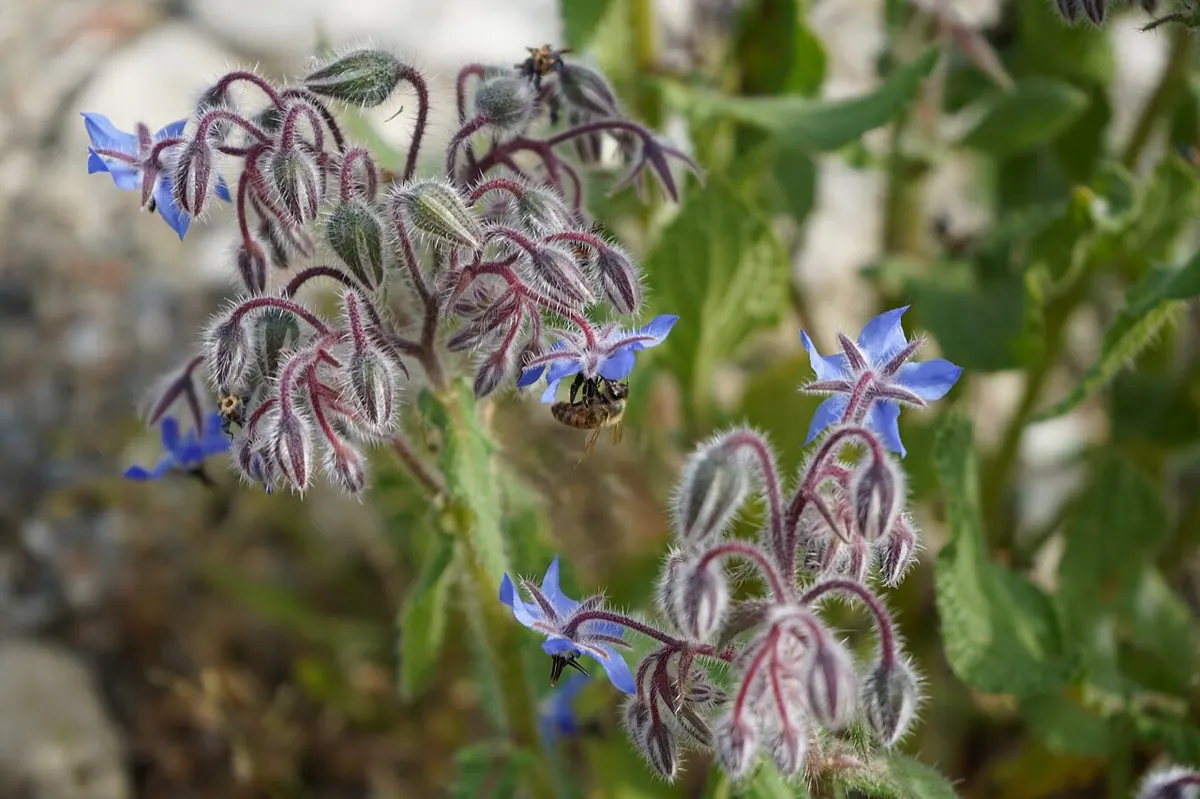
Photo: Christian Orlandi, CC BY-SA 4.0, Wikimedia Commons

Borage
Borago officinalis
EdibleBristly grey-green leaves that taste of cucumber under brilliant blue five-pointed stars, and a plant best eaten as a garnish, not a staple.
Confused with
Danger: Comfrey contains pyrrolizidine alkaloids that cause serious cumulative liver damage. It should never be eaten or drunk, whatever old herbals say, and several countries restrict its internal use.
How to tell: Comfrey flowers are hanging tubular bells, cream, pink or purple, never a flat blue five-pointed star with a black centre. Comfrey leaves run down the stem as narrow wings below where they join, which borage leaves do not. Both are bristly, so use the flower and the winged stem, not the hairs.
Danger: Both contain pyrrolizidine alkaloids and are not food. Not an acute poison, but real liver risk with repeated use.
How to tell: Green alkanet flowers are small flat blue discs 8-10 mm with a white eye, not pointed stars with a black cone, and viper bugloss has funnel-shaped flowers with long protruding red stamens on a spike. Borage stars are large, pointed and unmistakable once you know them. If the flower is not a clear five-pointed star with a black centre, leave it.
Danger: Deadly. Cardiac glycosides cause vomiting, visual disturbance, a dangerously slow or irregular heartbeat and death.
How to tell: Foxglove leaves are soft and grey-downy with a fine felt, not stiff bristles you can feel individually, and they are finely and evenly scalloped along the whole edge with a strong net of side veins. Borage leaves are harshly bristly, wavy-edged and smell of cucumber when crushed. Foxglove has no cucumber smell at all. Never gather a bristly or downy rosette without a flower unless the cucumber smell is unmistakable.
Leaves
Alternate, 5-15 cm, oval to lance-shaped with a wavy untoothed or slightly scalloped edge, dull grey-green, and covered all over in stiff white bristly hairs that make the leaf feel like a cat tongue. Lower leaves are stalked, upper leaves clasp the stem.
Flowers
Vivid sky-blue, 15-25 mm, with five sharply pointed petals forming a perfect star, and a tight black cone of stamens sticking out from the centre. They hang in nodding clusters and uncurl from a coiled shoot tip. Occasionally pink or white.
Stem
Round, thick, hollow when mature, juicy, and densely covered in the same stiff white bristles. Not square, not blotched.
Smell or taste
Crush a leaf and it smells clean and distinctly of cucumber. Confirmed safe once identified, and the taste follows the smell: cucumber with a salty edge.
Habitat
Waste ground, old vegetable plots, field edges, roadside banks, escaped garden ground. Native to the Mediterranean and common through Portugal and Spain, where it is also a traditional cultivated vegetable in Aragon.
Edible parts
Young leaves and the flowers. Use as a flavouring and a garnish, not a bulk vegetable.
Preparation
Pick the youngest leaves, since older ones are too bristly to eat raw. Chop them finely across the bristles into a salad, a yoghurt dip or a cold summer drink, or blanch them 2 minutes and drain, which softens the bristles completely. In Aragon the thick peeled stems are boiled 15 to 20 minutes and served with potato and oil, which is the one genuine bulk use, and even there it is an occasional dish. Flowers are the best part: pull the star free of the bristly green calyx by pinching the black centre, and use them fresh in salads, frozen into ice cubes, or candied. They keep their blue if not cooked. Do not make borage leaf a daily tea. Because of its pyrrolizidine alkaloid content, occasional culinary use is the sensible limit, and the leaf infusion that older herbals recommend is not something to drink regularly.
Traditional use
Borage carries the old European reputation summed up in the tag that it makes people glad, and it was traditionally taken in wine for low spirits and used as a cooling plant in fevers. Modern understanding has moved on: the seed oil is a commercial source of gamma-linolenic acid, but the leaf and flower should be treated as an occasional food, not a remedy.
Harvest rule
Borage is an annual that self-seeds heavily and is often a garden escape, so picking leaves and flowers costs nothing, but leave plenty of flowers because it is one of the very best bee plants in Europe and yields nectar continuously through the day. Never uproot it. Foraging law varies by country. In Portugal it usually grows on cultivated or disturbed private ground, so ask, and check ICNF rules inside protected areas.
Borragem, chupa-mel (PT), borraja (ES), bourrache (FR)