 Human Skills
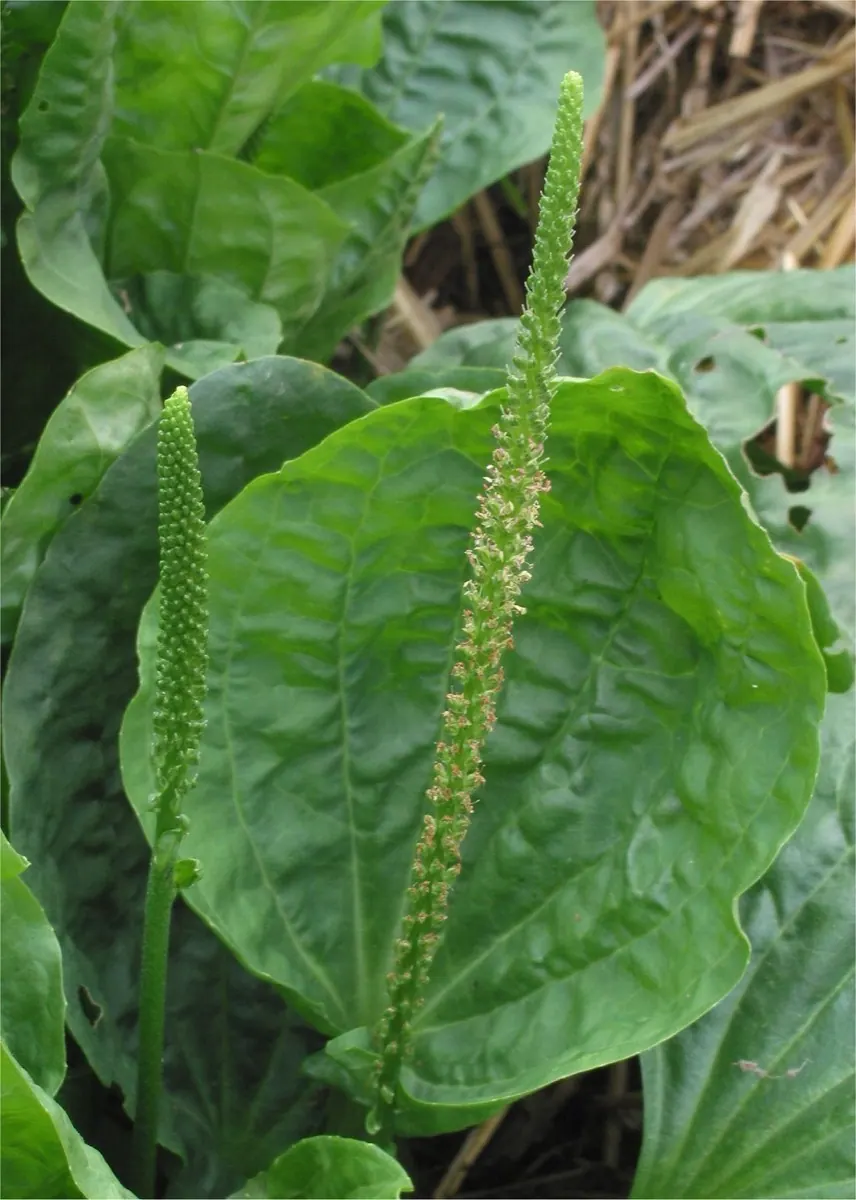
Photo: Rasbak, CC BY-SA 3.0, Wikimedia Commons

Broadleaf Plantain
Plantago major
EdibleThe tough rosette in every path and lawn, recognised instantly by the strings that stay behind when you tear a leaf slowly.
Confused with
Danger: None. It is equally edible and equally used in folk medicine.
How to tell: Ribwort has narrow lance-shaped leaves and a short dark flower head on a long deeply grooved stalk. Same parallel strings, same uses.
Danger: Deadly. Foxglove contains cardiac glycosides. A small amount of leaf can cause vomiting, visual disturbance, a dangerously slow or irregular heartbeat and death.
How to tell: Foxglove leaves are covered in soft grey down and have a net of branching side veins running out from one central midrib, with a finely scalloped edge. Plantain leaves are nearly hairless with several strong veins running parallel from base to tip that pull out as threads. If a rosette is soft, downy and net-veined, leave it. Foxglove also grows in acid woodland and banks, not in trodden paths.
Leaves
All basal in a rosette. Broad oval to almost round, 4-18 cm long, with a wide blade narrowing into a long channelled leaf stalk. Between five and nine strong parallel veins run from base to tip. Tear a leaf slowly and those veins pull out as tough white threads: this is the single best field check.
Flowers
A dense narrow greenish spike 5-15 cm long, like a rat tail, with tiny dull flowers and pale cream-purple stamens sticking out in a ring that moves up the spike as it opens.
Stem
No leafy stem. The flower spike is a slim, ridged, leafless stalk rising from the rosette centre, solid and tough.
Smell or taste
Practically no smell when crushed, faintly green. Confirmed safe once identified; the leaf is mild, slightly bitter and distinctly stringy.
Habitat
Compacted ground: footpaths, tracks, lawns, farm gateways, playing fields, the edges of dirt roads. It positively likes being trodden on. Common through Portugal wherever ground is damp enough.
Edible parts
Young leaves, and the seeds from the ripe spike.
Preparation
Take leaves under about 8 cm. Older leaves are too stringy to enjoy raw. Chop them fine across the veins for salad, or simmer 5 to 8 minutes in soup where the fibre stops mattering. A useful trick is to strip the blade away from the tough veins with your fingers and use the blade only. Seeds ripen from July. Run a thumb and finger up the spike over a bowl, winnow the chaff off in a breeze, and use them like a small grain, a tablespoon stirred into porridge or bread dough. They swell and gel in water in the same way as their close relative psyllium. For the traditional field poultice, wash a leaf, crush or chew it into a pulp and hold it against a graze, nettle sting or insect bite for 10 to 15 minutes. Use this for minor irritation only, and never on a deep or dirty wound.
Traditional use
One of the oldest wound herbs in Europe, traditionally crushed onto insect bites, stings and grazes, and the leaf infusion was folk-used as a soothing gargle and for coughs. The seed husk is the same family as commercial psyllium and was traditionally taken for sluggish bowels.
Harvest rule
Pick individual leaves and leave the crown, which regrows all season. It is abundant and in no need of protection, but the rule still holds: never take more than a third of a stand and never uproot. Foraging law varies by country, so check locally. In Portugal, stay out of fenced and cultivated land without permission, and follow ICNF restrictions inside protected areas.
Tanchagem-maior, língua-de-vaca (PT), llanten (ES), plantain majeur (FR)