 Human Skills
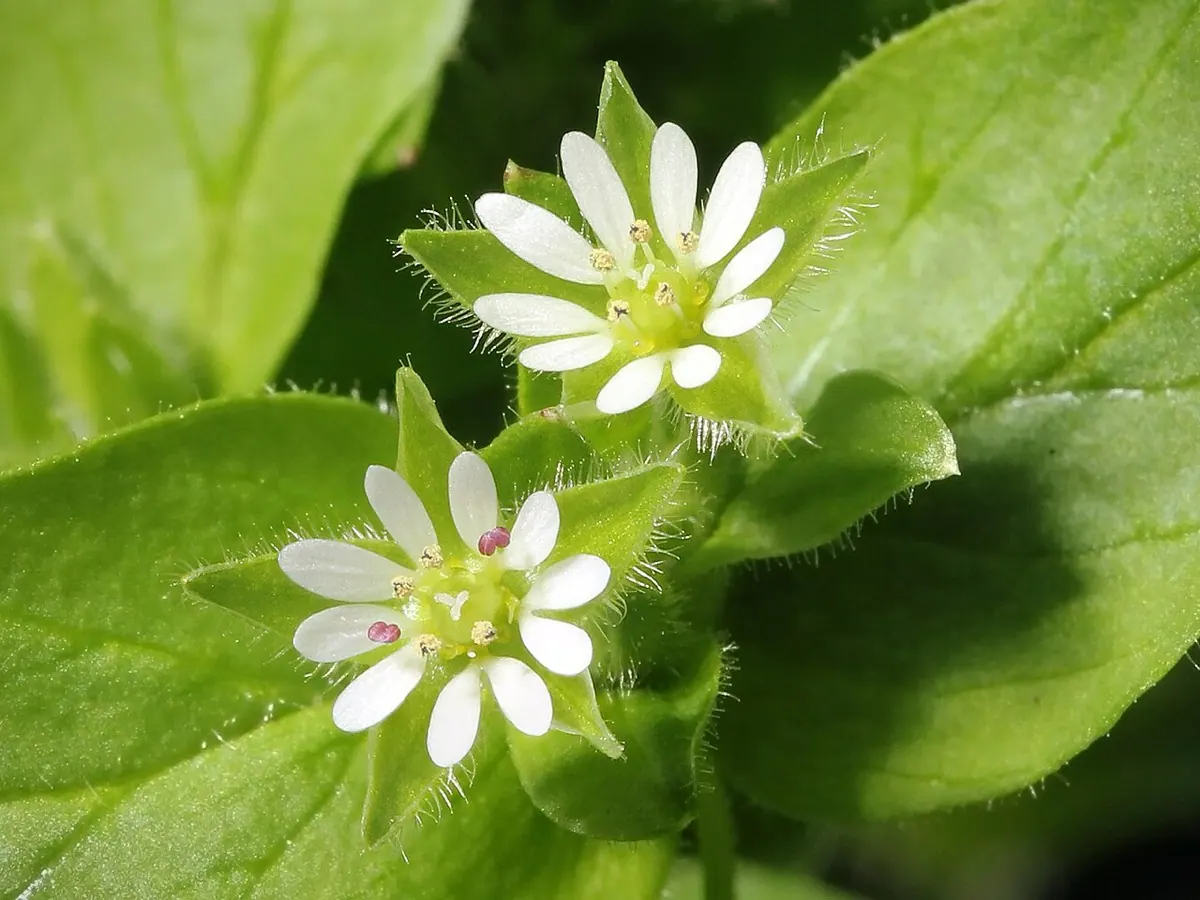
Photo: Kaldari, CC0, Wikimedia Commons

Chickweed
Stellaria media
EdibleA mild winter salad green settled by one test: a single line of hairs running up the stem that switches sides at every pair of leaves.
Confused with
Danger: Toxic. Contains saponins; causes stomach pain, vomiting and diarrhoea, and it grows in exactly the same disturbed ground.
How to tell: Pimpernel has a square stem with no line of hairs at all, leaves with obvious black dots on the underside, and orange-red (occasionally blue) flowers with five plain unsplit petals. Chickweed has a round stem with the single switching hair line and split white petals. Check the stem and the leaf underside before you pick.
Danger: Toxic and caustic. The white latex burns the mouth and is dangerous in the eyes.
How to tell: Break a stem. Any wild green that bleeds white milky latex is not chickweed. Chickweed sap is clear.
Danger: None. Edible but hairy and unpleasant.
How to tell: Covered in soft hairs all over the stem and leaves, not one line. Harmless, just not worth eating.
Leaves
In opposite pairs, small, 5-25 mm, oval with a pointed tip, fresh light green, hairless or almost so. The lower leaves have stalks, the upper ones sit directly on the stem.
Flowers
Tiny, 5-10 mm across, white, with five petals so deeply split that they look like ten. Five green sepals sit behind and are as long as, or longer than, the petals.
Stem
Round, weak, much branched, and carrying one single narrow line of fine white hairs running along one side only. That line changes sides at each pair of leaves. Stretch the stem gently and an inner elastic core pulls out of the outer sheath. Both features together are conclusive.
Smell or taste
No real smell when crushed, just a clean green note. Confirmed safe once identified; it tastes mild and sweet, close to young lettuce or raw sweetcorn.
Habitat
Bare cultivated soil, vegetable beds, greenhouse floors, flowerpots, shaded damp waste ground. In Portugal it is at its best from autumn to spring and dies back in the summer heat.
Edible parts
The whole above-ground plant while it is young and soft: stems, leaves and flowers.
Preparation
Cut the top 10 cm of a mat with scissors rather than pulling, since the shallow roots come up easily and bring grit with them. Wash well in two changes of water, because it grows flat on soil. Best raw. A double handful makes a salad on its own, dressed with oil, salt and lemon. It also makes a good green pesto: 100 g of chickweed, 50 g of toasted nuts or pine nuts, a garlic clove, 40 g of hard cheese, 100 ml of olive oil, blended. Cooked it collapses to very little, so use it in soup at the last 2 minutes. For the traditional skin use, simmer a large handful in 250 ml of water for 10 minutes, cool to body temperature, strain, and use the liquid on a cloth as a compress for 10 minutes on itchy unbroken skin.
Traditional use
Traditionally used in European folk medicine as a cooling external wash or ointment for itchy skin, nettle rash and minor irritation, and eaten as a gentle winter green when nothing else was growing. Its name records its long use as poultry food.
Harvest rule
Cut with scissors above the roots and the mat regrows within two weeks, so one patch can be cut several times a season. It is an abundant annual weed with no conservation concern, but the general rules still apply: take a third at most and never clear a patch. Foraging law varies by country; in Portugal keep to land you own or have permission on, and respect ICNF rules in protected areas.
Morugem-branca, esparguta (PT), pamplina, alsine (ES), mouron des oiseaux (FR)