 Human Skills
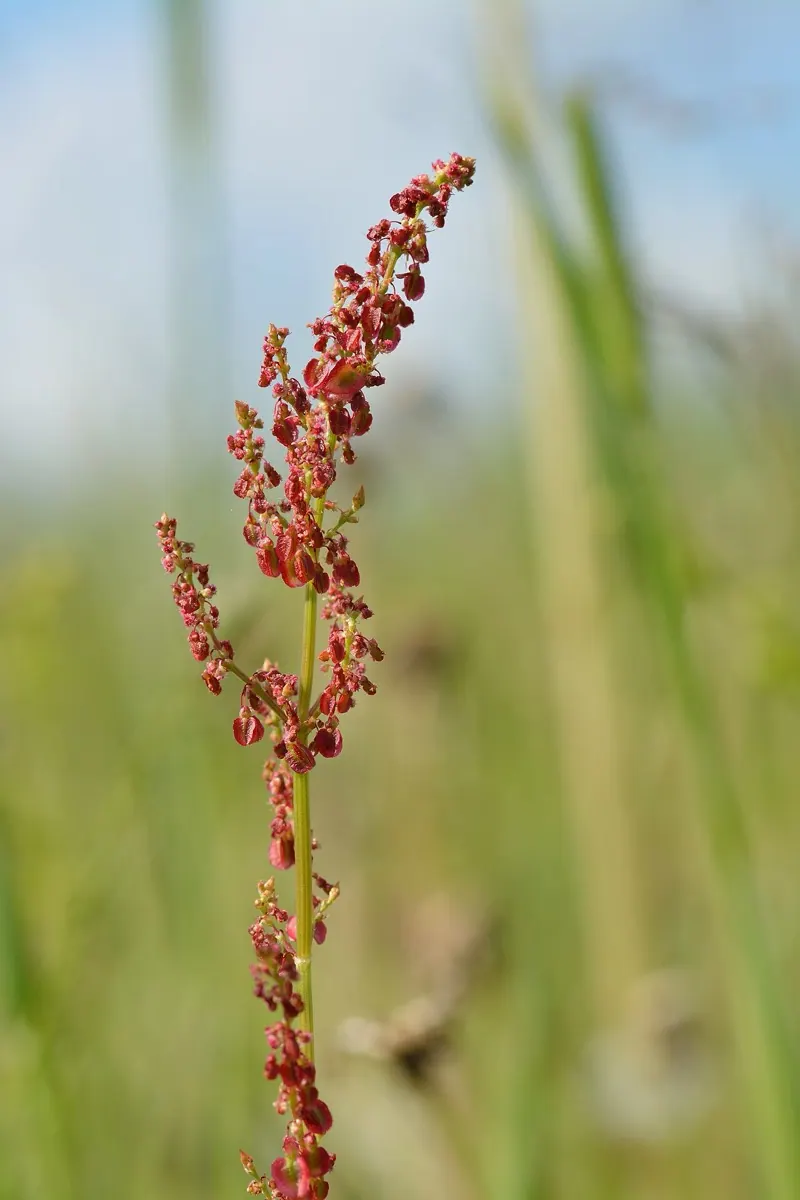
Photo: Ivar Leidus, CC BY-SA 3.0, Wikimedia Commons

Common Sorrel
Rumex acetosa
EdibleA sharp lemon-sour leaf shaped like an arrowhead with the barbs pointing backwards down the stalk.
Confused with
Danger: Severely toxic. The leaves are full of needle-like calcium oxalate crystals that cause immediate intense burning of the mouth, throat and lips, with swelling that can obstruct breathing. The red berries have killed children.
How to tell: Arum leaves are glossy, thick and deep green with a network of branching veins spreading across the blade, and their basal lobes are rounded and point outwards and downwards from a long fleshy stalk. Sorrel leaves are thin, matt, with a single clear midrib, sharply pointed backward barbs, and that papery sheath at the stem joint, which Arum never has. Arum italicum also shows pale veining along the veins. If the leaf is glossy, thick and net-veined, put it down.
Danger: None. Edible in the same way, just smaller.
How to tell: Much smaller, under 30 cm, with narrow leaves whose basal lobes stick out sideways like a halberd rather than pointing backwards.
Danger: Not toxic in small amounts but bitter, high in oxalic acid and unpleasant.
How to tell: Dock leaves are much bigger, blunt, with a heart-shaped base and no backward-pointing arrow barbs, and they are not sour.
Leaves
Arrow-shaped (sagittate): a long blade 3-12 cm with two pointed lobes at the base aimed backwards, down along the leaf stalk. Basal leaves are long-stalked; leaves up the stem clasp it directly with the backward lobes wrapped around. There is a thin papery sheath (an ochrea) where each leaf meets the stem, which is the signature of the dock family.
Flowers
Loose upright spikes of tiny flowers that turn from green to rusty red-brown as they ripen, often colouring whole meadows a copper red in early summer. No petals of note.
Stem
Upright, grooved, reddish towards the base, solid, hairless. Branches only in the flower head.
Smell or taste
Little smell. Once positively identified it is confirmed safe, and the taste is unmistakably lemon-sour, like green apple skin. Taste only to confirm a plant you have already identified by shape; never taste to identify.
Habitat
Old meadows, grassy banks, damp pasture, woodland edges, roadside grass. In Portugal it favours the cooler, wetter north and centre, and shaded damp ground further south.
Edible parts
Young leaves, before and during flowering.
Preparation
Use raw and sparingly: a few leaves shredded through a salad, or a handful stirred into an omelette or a fish sauce at the last minute. Heat turns sorrel from bright green to a drab olive in under a minute, so add it at the end. The classic use is a sauce: melt 20 g of butter, add 100 g of shredded sorrel, stir for 60 seconds until it collapses to a puree, add 100 ml of cream and a pinch of salt. That is enough for two people with fish. Do not cook sorrel in an untinned cast-iron or aluminium pan, since the acid reacts with the metal and gives a metallic taste. Sorrel does not dry well; use it fresh or freeze the puree in small portions.
Traditional use
Eaten as a spring sour green all over Europe, traditionally valued as a cooling food in hot weather and as a thirst-quencher for field workers. It has no significant folk-medicine role and is best treated purely as food.
Harvest rule
Pick outer leaves and leave the crown intact so the plant keeps producing, and never dig the perennial root. Old meadows with sorrel are increasingly rare habitat, so take a leaf or two per plant across a wide area rather than stripping one clump. Foraging law varies by country; in Portugal check ICNF rules in protected areas and get permission on farmland, where sorrel-rich pasture is usually somebody grazing ground.
Azedas, azeda-brava (PT), acedera (ES), oseille (FR)