 Human Skills
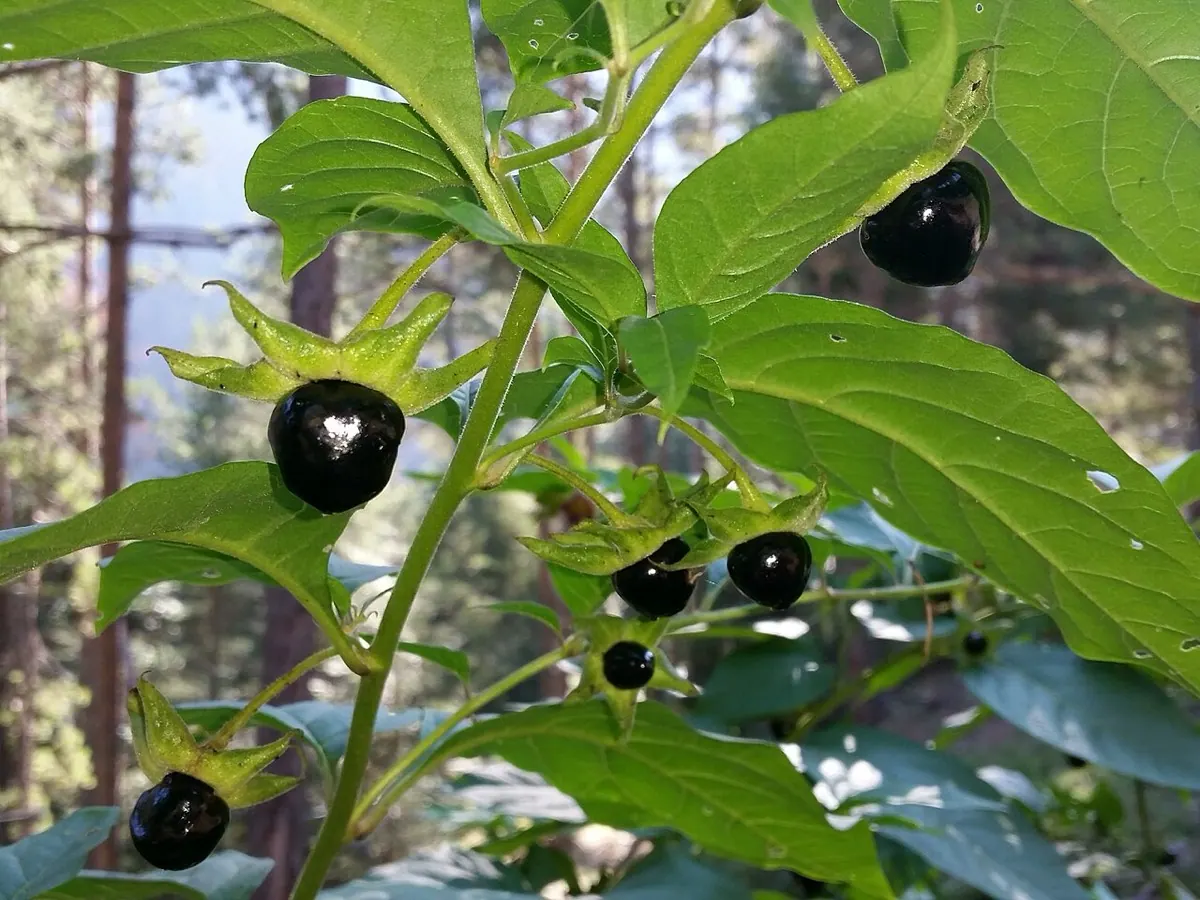
Photo: Joan Simon from Barcelona, España, CC BY-SA 2.0, Wikimedia Commons

Deadly Nightshade
Atropa belladonna
PoisonousTwo or three of its sweet black berries can kill a child, after hours of hallucination, racing heart and blindness to light.
Confused with
Danger: Atropine and scopolamine cause dry mouth, hugely widened pupils, blurred vision, flushed hot skin, a racing heart, confusion and hallucinations, then seizures and coma. Two to five berries can kill a small child.
How to tell: Look at how the berry sits. Deadly nightshade berries hang singly, each cupped in a flat green five-pointed star that spreads out behind it like a ruff. Bilberries have a small crown pit on top, currants hang in strings, and blackberries are clusters of tiny beads. A single glossy black berry on a green star is a hospital case.
Danger: Leaf-only gathering in shady ground can pick up belladonna foliage, which is as poisonous as the berries.
How to tell: Deadly nightshade leaves have a plain untoothed edge, no bristles, and come in unequal pairs of one large and one small leaf. Comfrey and borage are harshly bristly. Do not gather leaves in scrub where you have seen purple-brown bells.
Leaves
Dull dark green, oval to pointed-oval, 5 to 20 cm long, untoothed with a smooth wavy edge, slightly downy. Alternate lower down but paired unequally higher up, with one large leaf and one small leaf side by side at the same point. That unequal pairing is a good confirming feature.
Flowers
Solitary nodding bells 2.5 to 3 cm long, dull purple-brown outside and dirty yellowish-green inside with purple veins, hanging singly from the leaf junctions. They become berries that ripen from green through red to glossy jet black, about 1.5 cm across, each sitting in a flat five-pointed green star of sepals that spreads out behind it.
Stem
Green to purplish, round, softly hairy and slightly sticky, branching widely. Not hollow.
Smell or taste
Crushed foliage smells rank and faintly sickly. The berries taste sweet, which is exactly why children eat them. Never taste anything.
Habitat
Limestone and chalk soils, woodland edges, scrub, quarries, old walls, ruins and shady disturbed ground. Local rather than common in Portugal, more frequent in northern and central Europe.
Preparation
No preparation makes it safe. Cooking, drying, jam-making and steeping in alcohol do not destroy the tropane alkaloids. Honey from bees working belladonna has poisoned people. Never make anything from it.
Traditional use
The name belladonna comes from Renaissance women dropping berry juice into their eyes to widen the pupils. It is the historical source of atropine and scopolamine, which are still real hospital drugs, and it was used in witches' flying ointments. Atropine today is purified, assayed and dosed by microgram under laboratory control. Home extraction or dosing is lethal and the effective and fatal amounts overlap.
Harvest rule
Remove it from around houses, play areas and paddocks. Gloves on, dig out the thick root, bag the whole plant with its berries and dispose of it as waste rather than composting it. Never burn it near people. Where it is a native part of a woodland far from children and stock, leaving it alone and teaching people to recognise it is better than clearing it. Check whether it is locally protected before clearing wild populations.
Beladona, erva-moira-furiosa (PT); belladonna (EN)