 Human Skills
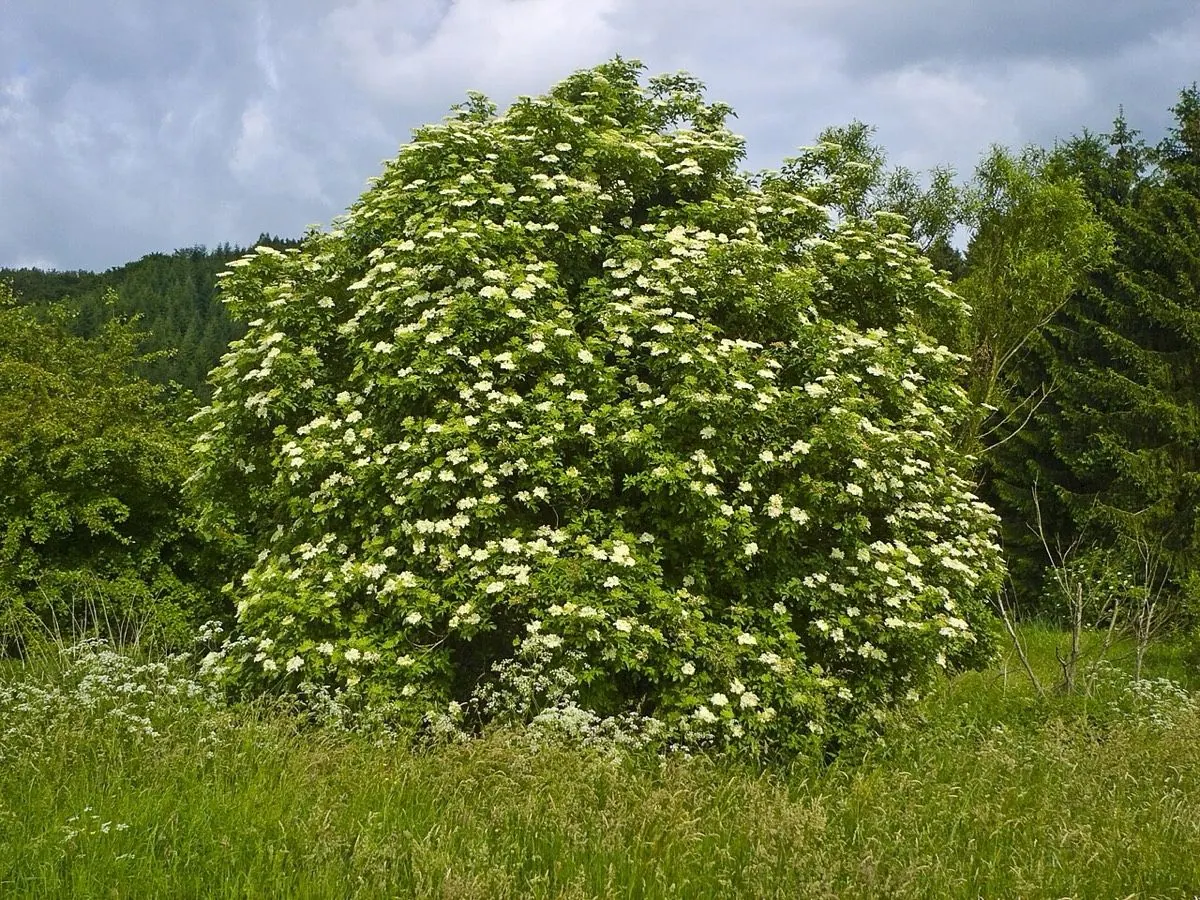
Photo: Willow, CC BY 2.5, Wikimedia Commons

Elder
Sambucus nigra
EdibleTwo harvests a year from one small tree, under one hard rule: the flowers are safe raw, the berries must be cooked, and every green part is never food.
Confused with
Danger: Toxic. Causes severe vomiting, cramping and diarrhoea, and it is much more strongly poisonous than common elder. It is widespread in Portugal and the Mediterranean and its flowers and berries look extremely similar.
How to tell: Dwarf elder is a herb, not a tree: it dies back to the ground every winter, grows 1-2 m in colonies of straight unbranched green stems with no bark and no woody trunk anywhere, and it carries a ruff of long leafy bracts at the base of the flower head. Its berries stand upright on the plant, while common elder berry clusters hang down and droop under their own weight. Its flowers usually show pink or purple anthers. The absolute check is simple: no woody trunk means it is not elder, and berries that point up are not elder.
Danger: Raw fruit and seeds cause vomiting. The seed is the toxic part.
How to tell: Red berries in a dome-shaped, not flat, cluster, ripening in early summer. If berries are red, leave them.
Danger: Varies; guelder rose berries cause stomach upset raw.
How to tell: Elder has opposite pinnate leaves and white spongy pith in the twigs. Rowan leaves are alternate, guelder rose leaves are lobed like a maple, not pinnate.
Danger: Deadly, because poison hemlock and hemlock water-dropwort make similar flat white flower heads at similar height in a hedge or ditch, and a casual glance from a car or across a field can confuse them.
How to tell: Get close. Elder is woody with bark and a trunk and its flowers sit on a woody shrub with opposite pinnate leaves. Hemlock is a green herb with a purple-blotched hollow stem and fern-like leaves, and it dies down each year. Never pick a white flower head without checking whether you are standing at a bush or at a herb.
Leaves
Opposite pairs, pinnate, each leaf made of 5 to 7 leaflets along a central stalk with one at the tip. Leaflets 4-12 cm, oval, pointed, sharply toothed, dull green and slightly rough.
Flowers
Flat-topped creamy-white umbel-like heads 10-25 cm across, made of thousands of tiny five-petalled flowers, in May and June. The whole head sits in one plane like a plate.
Stem
Young shoots are soft with a thick white spongy pith inside, which is the classic check: snap a twig and you should see a wide core of white foam-like pith. Older bark is grey-brown, corky, deeply grooved and warty.
Smell or taste
The flowers smell sweet, heavy and muscat-like, with a faint catty undertone in strong sun. Crushed leaves smell rank and unpleasant, which is a useful warning that the green parts are not food. Never taste raw berries to test ripeness.
Habitat
Hedges, woodland edges, riverbanks, old walls, farmyards, waste ground, often on nitrogen-rich soil near buildings. Common in northern and central Portugal, especially around Minho and Beira villages where it is planted at field edges.
Edible parts
Flowers, and ripe black berries once cooked. Never eat the leaves, bark, roots, green stems, unripe green berries or the raw berries.
Preparation
Flowers: pick whole heads on a dry sunny morning when most florets are open and the smell is strongest, and use them the same day, since they go fishy fast. Do not wash them, which strips the pollen that carries the flavour; shake the insects out instead. Snip the florets off with scissors and discard as much green stalk as you can, because the green stalk is what makes a cordial bitter and is the part you should not be eating. For cordial: 20 to 25 heads, 1.5 litres of water brought to a boil and cooled slightly, 1 kg of sugar dissolved in it, the juice and zest of 2 lemons and 50 g of citric acid. Steep 24 hours, strain through a cloth, bottle and refrigerate, or freeze it. Fritters are made by dipping whole heads in a thin batter and frying 1 minute a side. Berries: pick whole clusters in late August and September only when every berry in the head is fully black and the cluster hangs down. Strip the berries off the stalks with a fork and discard every piece of green stalk and every red or green berry. Raw elderberries contain cyanogenic glycosides and sambunigrin: eaten raw in any quantity they cause nausea, vomiting and diarrhoea, and there are documented mass poisonings from raw elderberry juice. Cooking destroys this. Simmer the berries with a splash of water for at least 20 minutes at a proper simmer before use. For a syrup, simmer 500 g of destalked berries in 300 ml of water for 20 to 25 minutes, mash, strain through a cloth, then add 300 g of sugar per 500 ml of juice and boil 5 more minutes. Bottle hot, refrigerate, use within 2 months or freeze in portions. For jelly, follow the same route with added apple for pectin. Never make an uncooked elderberry drink.
Traditional use
Elderflower and elderberry preparations have been used across Europe as a traditional winter remedy for colds and feverish chills, the flowers as a hot infusion to encourage sweating and the berry syrup taken by the spoonful. The elder tree also carries deep folklore as a protective tree, and its pithy stems were traditionally hollowed into whistles and blowpipes.
Harvest rule
Never strip a tree of flowers, because every flower head you take is a berry cluster gone: take no more than a third of the heads, and leave the ones highest and deepest for the birds. Berries in autumn are a major food for thrushes and warblers on migration, so take a share, not the crop. Do not break branches to reach heads; use a hook or a pole. Foraging law varies by country. In Portugal elder is frequently planted deliberately at the edge of smallholdings and near houses, so it very often belongs to somebody even when it looks wild: ask. ICNF rules apply inside protected areas.
Sabugueiro (PT), sauco (ES), sureau noir (FR)