 Human Skills
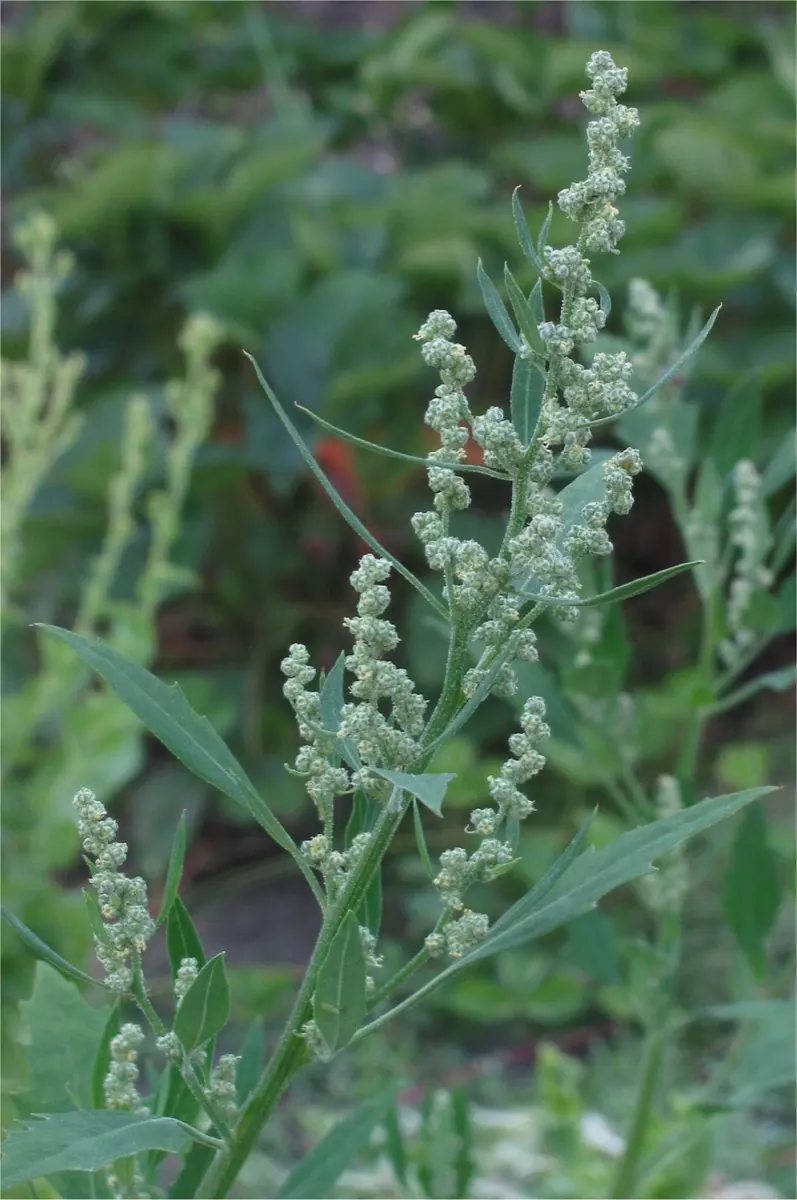
Photo: Rasbak, CC BY-SA 3.0, Wikimedia Commons

Fat Hen
Chenopodium album
EdibleA serious staple green, identified by the white mealy dust on the newest leaves that rubs off between your fingers.
Confused with
Danger: The green berries and leaves contain solanine and can cause serious poisoning, especially in children. It grows in exactly the same vegetable-plot ground.
How to tell: Nightshade has no white mealy dust anywhere, its leaves are plain oval and slightly shiny, and it carries obvious star-shaped white flowers with a yellow cone of anthers, followed by round green or black berries. Fat hen flowers are dusty green nothings. If you see white star flowers or any berry, it is not fat hen.
Danger: None. Edible in the same way and often growing alongside.
How to tell: Orache leaves are often more triangular with spreading basal lobes, and the seeds sit between two flat triangular bracts. Cook and eat it identically.
Danger: Not deadly, but revolting and it will spoil everything it touches.
How to tell: Crush a leaf: it smells strongly of rotting fish. Fat hen has almost no smell.
Leaves
Alternate, not opposite. Diamond to goose-foot shaped, 2-8 cm, with a few irregular blunt teeth, the lower ones broader and the upper ones narrower and nearly untoothed. The growing tip and the underside of young leaves are coated in a fine white-grey mealy powder that rubs off on your fingers and makes water bead on the leaf.
Flowers
Dense clusters of tiny green petal-less flowers in spikes at the top and from the leaf joints, greenish and dusty-looking, turning to masses of small black seeds.
Stem
Upright, ridged and grooved, often striped with red or purple, solid, hairless but mealy when young. Not hollow, not blotched.
Smell or taste
Almost no smell when crushed, a faint dusty greenness. Confirmed safe once identified and cooked; the taste is very close to spinach, slightly earthier.
Habitat
Rich disturbed ground: vegetable plots, manure heaps, arable field edges, building sites, riverbanks. Extremely common across Portugal in summer, where it is often the biggest weed in an irrigated plot.
Edible parts
Young leaves and growing tips, and the seed in autumn.
Preparation
Pick the top 10 to 15 cm of shoots and the young leaves; older lower leaves get tough and dusty. Wash, then boil for 3 to 5 minutes and drain, which reduces the oxalate and the saponins and gives you a clean spinach substitute. Do not make it a raw daily salad staple; cook it. 500 g of fresh tops cooks down to about 150 g. It freezes well blanched for 2 minutes, squeezed dry and bagged. The seed is a real grain: cut whole seeding tops in September, dry them on a sheet for a week, rub and winnow. Because the seeds carry saponins, soak them overnight, rinse through a fine sieve until the water no longer foams, then simmer 1 part seed to 3 parts water for about 20 minutes. Treat exactly like its cultivated relative quinoa, which is the same genus.
Traditional use
Historically a major European food plant, found in the stomach of preserved Iron Age bodies and grown deliberately before spinach arrived. It has essentially no folk-medicine role and should be treated as a staple vegetable, not a remedy.
Harvest rule
An annual weed with no conservation concern, and pinching the tops makes it bush out and produce more, so it can be cut repeatedly. Even so, leave some plants to seed if you want it back next year. Foraging law varies by country: in Portugal it grows mostly in cultivated ground, which is private, so ask the landowner. Inside ICNF protected areas, check the local rules before collecting anything.
Catassol, erva-branca, quenopódio (PT), cenizo (ES), chenopode blanc (FR)