 Human Skills
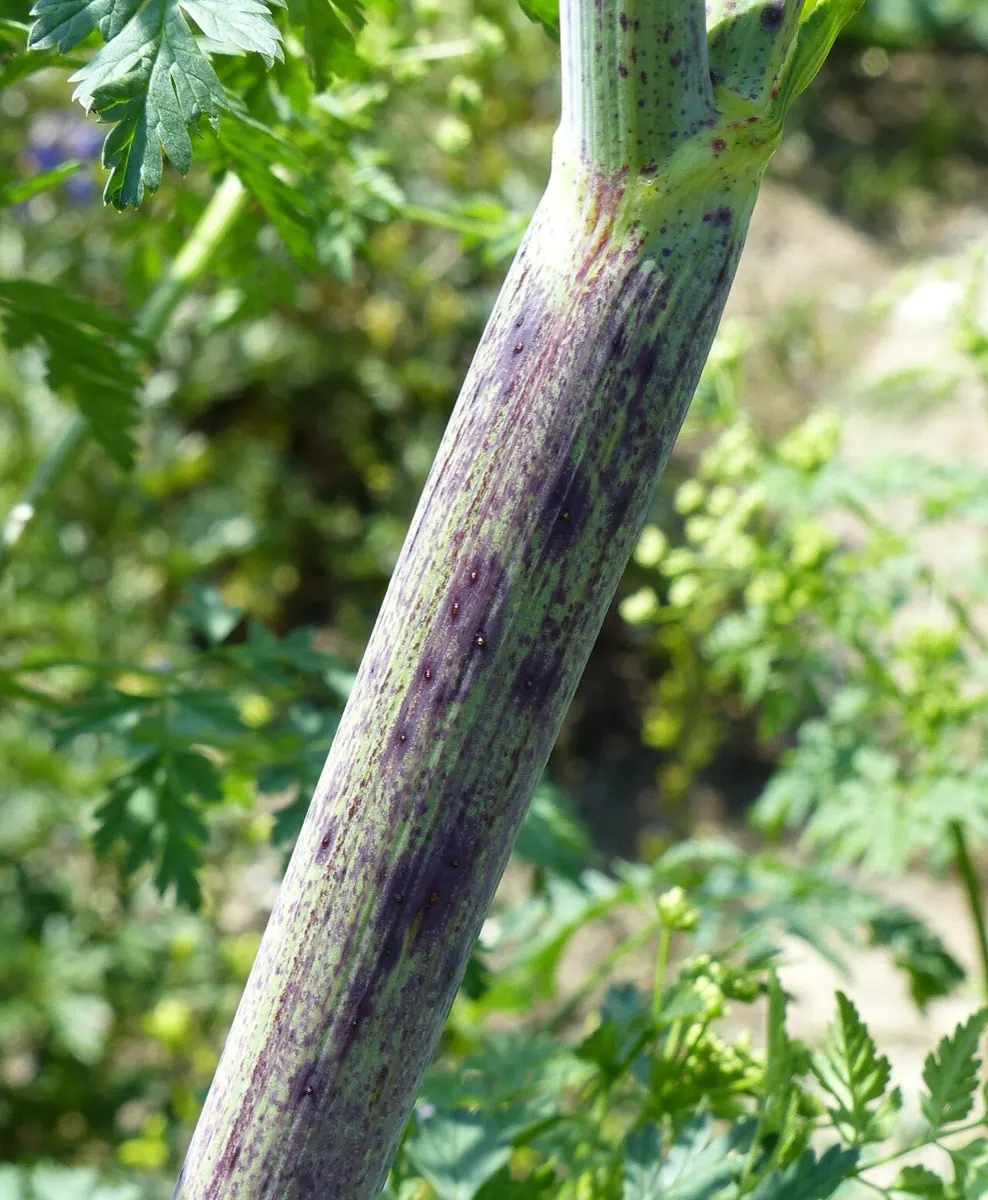
Photo: Andrea Moro, CC BY-SA 4.0, Wikimedia Commons

Hemlock
Conium maculatum
PoisonousA few mouthfuls paralyse the muscles you breathe with, and you stay conscious while it happens.
Confused with
Danger: Eating hemlock as fennel causes vomiting, then creeping muscle paralysis moving from the feet upward. Death comes from the breathing muscles failing while the mind is clear. There is no antidote, only hospital ventilation.
How to tell: Crush a leaf in your fingers and smell it. Fennel smells strongly of aniseed or liquorice, unmistakably. Hemlock smells foul and musty. Then look at the lower stem: fennel is solid-feeling, blue-green and never purple-blotched, hemlock is hollow and blotched purple.
Danger: The same paralysis. Children have died after using hollow hemlock stems as peashooters or whistles, without eating the plant at all.
How to tell: Wild carrot stems and leaves are distinctly hairy and the stem is solid and never blotched. Hemlock is completely hairless with purple-blotched hollow stems. Run the stem through your fingers: bristly means carrot, smooth means stop.
Danger: First-year hemlock rosettes look very like parsley. A handful in a soup can kill an adult.
How to tell: Parsley leaves are divided only two times into broad flat lobes and smell clean and green when crushed. Hemlock leaves are divided three or four times into much finer segments and smell musty. Never pick parsley-like leaves from the wild at all.
Leaves
Bright green, soft, triangular in outline, up to 50 cm long, divided three or four times into fine fern-like segments. Alternate on the stem, each leaf base wrapping the stem in a sheath. The leaflets are toothed and slightly glossy on top, dull below.
Flowers
Small white flowers in flat-topped umbels 3 to 6 cm across, many umbels per plant. Each umbel sits on a hairless stalk. There are small bracts under the main umbel and under each little umbel.
Stem
Hollow, hairless, smooth, strongly ridged, and marked with purple to reddish-brown blotches and streaks, heaviest on the lower stem. The blotches are the single most useful feature. No hairs anywhere.
Smell or taste
Crushed leaves and stem smell unpleasant and musty, often described as mouse urine, stale parsnip or a sour chemical smell. Never taste any part, and never use taste to identify anything in this family.
Habitat
Damp waste ground, ditch banks, roadsides, riverbanks, field edges, abandoned lots and irrigation channels. Very common across mainland Portugal and most of Europe, often in large stands.
Preparation
There is no preparation that makes hemlock safe. Cooking, boiling, drying, freezing and fermenting do not destroy coniine and the related alkaloids. Dried hemlock in hay has killed livestock. Do not put it anywhere near food.
Traditional use
Famous in history as the poison used to execute Socrates, and used in the past as a sedative and antispasmodic in tiny apothecary doses. Those preparations killed people regularly. There is no safe home use of any kind.
Harvest rule
You never harvest hemlock, you only remove it. Wear waterproof gloves, long sleeves and eye protection, pull or dig before it seeds, and bag the whole plant. Never burn it, as the smoke is toxic. Do not compost it near vegetable beds and do not feed it to any animal. Keep children and livestock off the area until the plants are gone.
Cicuta, cicuta-maior, funcho-dos-asnos (PT); poison hemlock (EN)