 Human Skills
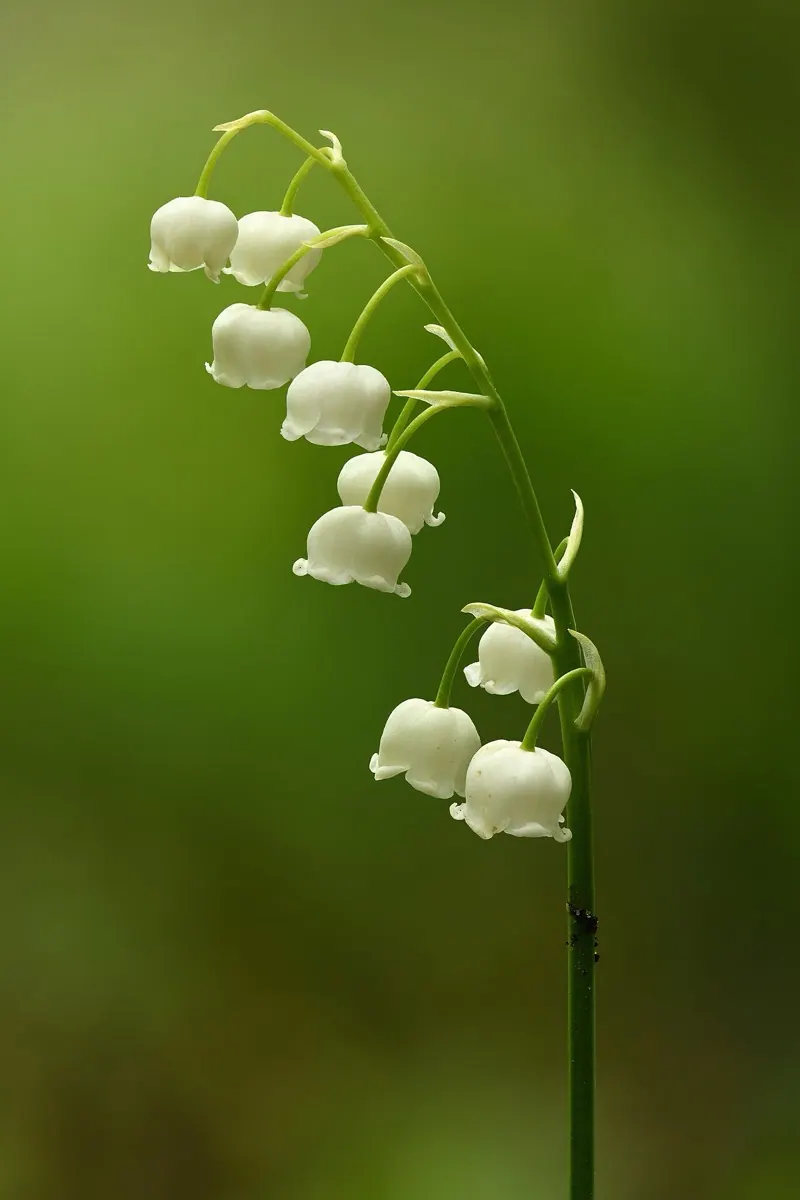
Photo: Ivar Leidus, CC BY-SA 4.0, Wikimedia Commons

Lily of the Valley
Convallaria majalis
PoisonousA heart poison in the same class as foxglove, hidden in a sweet-smelling garden favourite.
Confused with
Danger: Convallatoxin and its relatives act on the heart like digitalis: vomiting, blurred or yellow vision, confusion and a slow or chaotic heartbeat that can stop. Poisonings from leaves gathered as wild garlic are recorded every spring in Europe.
How to tell: Smell the crushed leaf. Wild garlic is unmistakably garlic. Lily of the valley smells of nothing. Then look at the base: lily of the valley sends up exactly two broad leaves wrapped together in one sheath, wild garlic leaves come up singly each on its own long thin stalk. Two leaves from one sheath with no garlic smell means stop.
Danger: Both are gathered in shady ground in spring and both can be confused with this. The result is a heart poisoning.
How to tell: Solomon's seal has leaves alternating up an arching stem, not rising from the ground. Lily of the valley leaves rise straight from the soil with no leafy stem at all.
Leaves
Usually two, occasionally three, broad elliptical leaves 10 to 20 cm long and 3 to 6 cm wide, deep green, glossy, with strong parallel veins running the length of the leaf, rising from a single sheathed base at ground level and curving over.
Flowers
A one-sided arching spike of small nodding white bells 5 to 9 mm across with six turned-back lobes, strongly and sweetly scented. Followed by red-orange berries 6 to 12 mm.
Stem
No leafy stem. A separate leafless flower stalk rises from between the leaf bases.
Smell or taste
The flowers smell sweet and unmistakable. The leaves have no garlic smell whatsoever. Never taste any part.
Habitat
Shady woodland on limestone, old gardens, shaded banks and churchyards, often as a naturalised carpet. Scattered in northern Portugal, common in central and northern Europe.
Preparation
No preparation makes it safe. Drying concentrates the glycosides, boiling puts them in the water, and even the water from a vase of cut flowers is poisonous. Never use it in tea, soup, tincture or flavouring.
Traditional use
Used in old herbal practice as a heart tonic and in some pharmacopoeias for heart failure, and still used in a few countries as a standardised extract. The dose that helps and the dose that kills are close together, standardised extracts are assayed in a laboratory, and no home preparation can be measured. Do not attempt it.
Harvest rule
Do not harvest it. Keep it out of vegetable gardens and out of any bed where you gather greens, and out of paddocks and poultry runs. If you remove it, wear gloves, dig out the creeping rhizomes, bag the material and do not compost it near food beds. Where it grows wild it may be locally protected, so check before clearing.
Lirio-do-vale, convalaria (PT); lily of the valley (EN)