 Human Skills
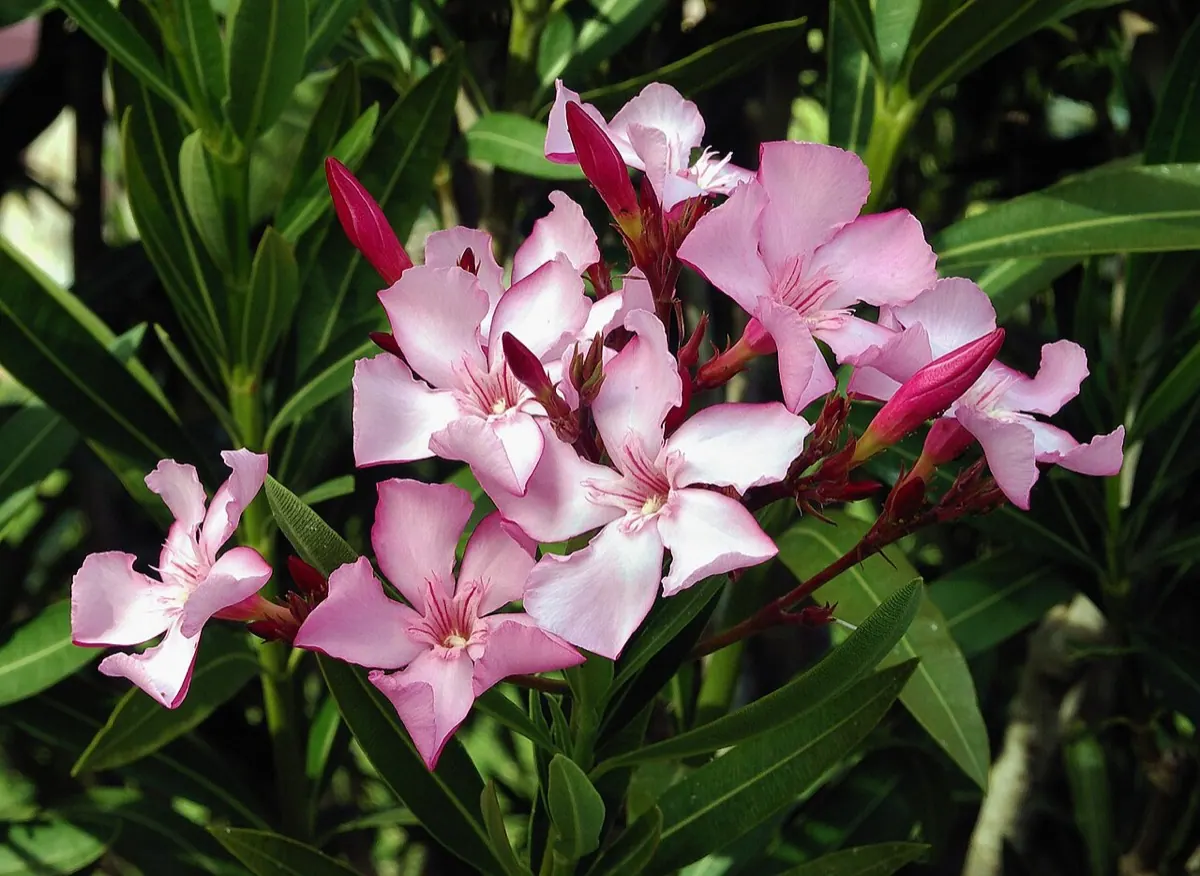
Photo: Alvesgaspar, CC BY 2.5, Wikimedia Commons

Oleander
Nerium oleander
PoisonousA single leaf can stop an adult's heart, and its smoke and its wood are poisonous too.
Confused with
Danger: Oleandrin acts like digitalis: vomiting, abdominal pain, then a slow or chaotic heartbeat and cardiac arrest. A single leaf is a recorded lethal dose in a child and can kill an adult.
How to tell: Count the leaves at a node and crush one. Bay leaves are alternate, broader, wavy-edged, and smell strongly aromatic when crushed. Oleander leaves come in whorls of three, are narrow with a pale midrib and dense parallel veins, and have no aromatic smell. Never gather bay from a decorative hedge.
Danger: Oleander sticks used as skewers, spits or barbecue fuel have poisoned whole groups of people. The smoke itself carries the toxin.
How to tell: Do not use unknown wood for cooking. Olive leaves are silver-grey underneath and opposite in pairs. Oleander is glossy green both sides in whorls of three and bleeds sticky sap when cut. If you cannot name the tree, do not cook with it.
Leaves
Leathery, stiff, dark green, narrow lance-shaped, 8 to 20 cm long and 1 to 3 cm wide, with a pale prominent midrib and dense parallel side veins. Arranged in whorls of three, sometimes opposite. The whorls of three are the quickest check.
Flowers
Showy five-lobed flowers 3 to 5 cm across in clusters at the shoot tips, pink, white, red or apricot, often double in garden forms, with a frilled centre. Long narrow seed pods split to release silky-plumed seeds.
Stem
Woody, grey-brown, many upright stems from the base. Broken twigs and leaves leak a clear to milky sticky sap.
Smell or taste
Flowers are faintly sweet-scented. Leaves smell of almost nothing. Never taste any part.
Habitat
Dry riverbeds and ramblas in the wild across the Mediterranean, and planted everywhere in Portugal and Spain in gardens, roundabouts, car parks, school grounds and motorway verges.
Preparation
Nothing makes oleander safe. Drying does not reduce it, boiling puts the toxin in the water, and burning puts it in the smoke. Do not use the wood for skewers, spits, fuel or smoking food. Do not use flower water or leaf infusions on skin or as a wash.
Traditional use
Used historically as a rat poison and, in some folk traditions, in wildly dangerous remedies for skin complaints and heart conditions. Every one of those uses has killed people, and it remains a common agent of fatal poisoning around the Mediterranean and in South Asia. There is no home preparation of any kind.
Harvest rule
Never harvested, only pruned or removed. Gloves, long sleeves and eye protection, and bag every clipping. Never burn it and never leave prunings where stock, poultry or pets can reach them. Take prunings to a municipal green waste point rather than a bonfire. If you keep animals, take oleander out of the boundary planting entirely.
Loendro, aloendro, cevadilha (PT); oleander (EN)