 Human Skills
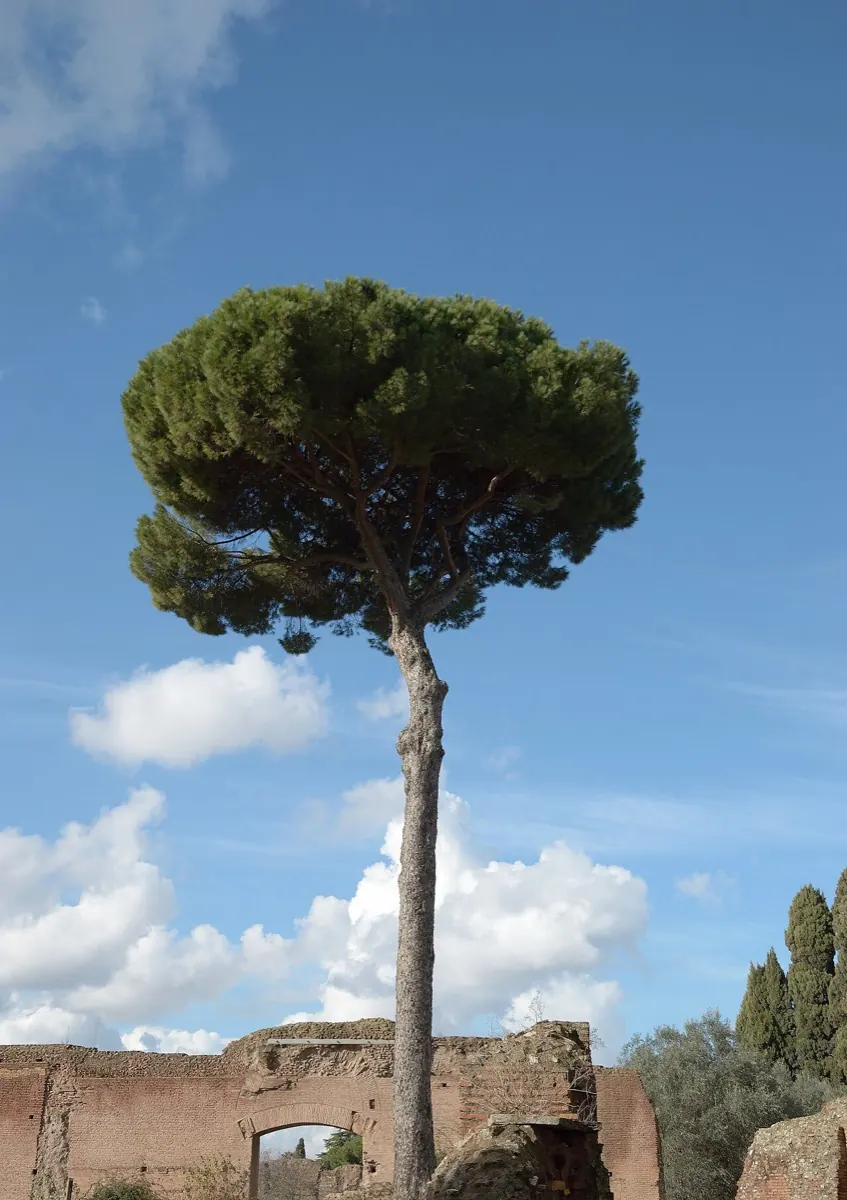
Photo: Livioandronico2013, CC BY-SA 4.0, Wikimedia Commons

Pine Nut (Stone Pine)
Pinus pinea
EdibleThe umbrella pine of the Portuguese coast gives the best pine nut in the world, locked inside a hard shell in a cone that takes three years to ripen.
Confused with
Danger: No poisoning risk, but their seeds are tiny, winged and not worth gathering, and you will waste a day.
How to tell: Stone pine has a flat umbrella crown and heavy rounded cones with fat blunt scales and big wingless seeds. Maritime pine has a tall conical crown and long pointed cones with small winged seeds. Look at the crown shape from a distance and the cone in the hand.
Danger: Deadly. Every part except the red flesh of the aril is lethally toxic, and the seed inside that red fruit will kill. Yew poisoning causes vomiting, collapse and cardiac arrest with very little warning and no reliable antidote.
How to tell: Yew is not a pine and has no cones and no needle bundles: its needles are flat, soft, dark green with a paler underside, and set singly in two flat rows along the twig, and its fruit is a single seed sitting in a soft red open-ended cup. If there are no bundles of two long needles bound at the base, and no woody cone, it is not a stone pine. Never eat any seed from a red berry-like fruit on a conifer.
Danger: Not poisonous but they cause pine mouth, a persistent bitter metallic taste lasting one to two weeks after eating. It is unpleasant rather than harmful.
How to tell: A shop problem rather than a foraging one: nuts you shell yourself from a stone pine cone are not affected.
Leaves
Needles in bundles of two, bound at the base by a small papery sheath, stiff, 10-20 cm long, sharp-tipped, bright to grey-green, slightly twisted. Juvenile trees carry shorter blue-grey single needles.
Flowers
Not a flowering plant. Male cones are small yellow clusters in spring; female cones are the harvest, taking about three years to mature into a rounded glossy brown cone 8-15 cm with thick blunt scales.
Stem
Thick trunk with grey-brown to orange-red bark that breaks into large plates separated by deep dark fissures, often flaking. The crown branches low and spreads wide.
Smell or taste
Crushed needles smell strongly and cleanly of resin and pine. The raw kernel is confirmed safe once shelled from a correctly identified stone pine and tastes sweet, oily and faintly resinous.
Habitat
Coastal sands and inland sandy soils: the Alentejo litoral, the pine woods around Setubal, Alcacer do Sal and Leiria, the Algarve, and throughout Mediterranean Europe. Widely planted as a crop tree.
Edible parts
The seed kernels, shelled out of mature cones.
Preparation
Collect closed brown cones that have fallen, or ripe cones in autumn and winter. A green cone is not ready and will not open. Dry the cones to open them. Spread them in full sun on a sheet or a roof for one to three weeks, or put them in a warm oven at 60 C for a few hours, and the scales crack open with a series of clicks. Shake the cone over a sheet or knock it on a hard surface and the black-coated seeds fall out. One good cone gives roughly 50 to 100 seeds, and 1 kg of seeds in their hard shell gives about 300 to 400 g of kernels. The shell is hard. Rub the sooty coating off the seeds, then crack them one at a time on their flat side with a stone or a light hammer, or use a nutcracker, working gently so the kernel comes out whole. A brief soak in water for an hour softens the shell and makes cracking cleaner. Eat the kernels raw or toast them dry in a pan over medium heat for 2 to 3 minutes, shaking constantly, until they just colour. They burn in seconds. Pine nuts are extremely oily and go rancid fast: store the kernels in a sealed jar in the fridge for up to 3 months or the freezer for a year, and store them still in the shell if you want them to keep longer. A rancid pine nut tastes like old paint and should be thrown away.
Traditional use
Pinhao is a food tradition, not a remedy: it appears in Portuguese Christmas sweets, in Alentejo cooking and all around the Mediterranean in pesto, pastries and rice dishes. Pine resin and needle infusions have separate folk uses, but the nut is simply one of the highest-value wild foods in Iberia.
Harvest rule
This one has real legal teeth in Portugal. Pinha, the stone pine cone crop, is a commercial harvest worth serious money, it is licensed and organised on a season, and unauthorised cone gathering is prosecuted as theft. Cones are also frequently sprayed or netted. Do not gather cones on private or managed pine estates, and do not climb trees or use poles, which is licensed professional work. What you can reasonably do is pick up fallen cones and loose seeds on public ground with permission, and buy the rest. Inside ICNF protected areas and the coastal pine reserves, collection rules apply and dune systems are off limits. Foraging law varies by country; here, ask first.
Pinhao, pinheiro-manso (PT), pinon, pino pinonero (ES), pignon, pin parasol (FR)