 Human Skills
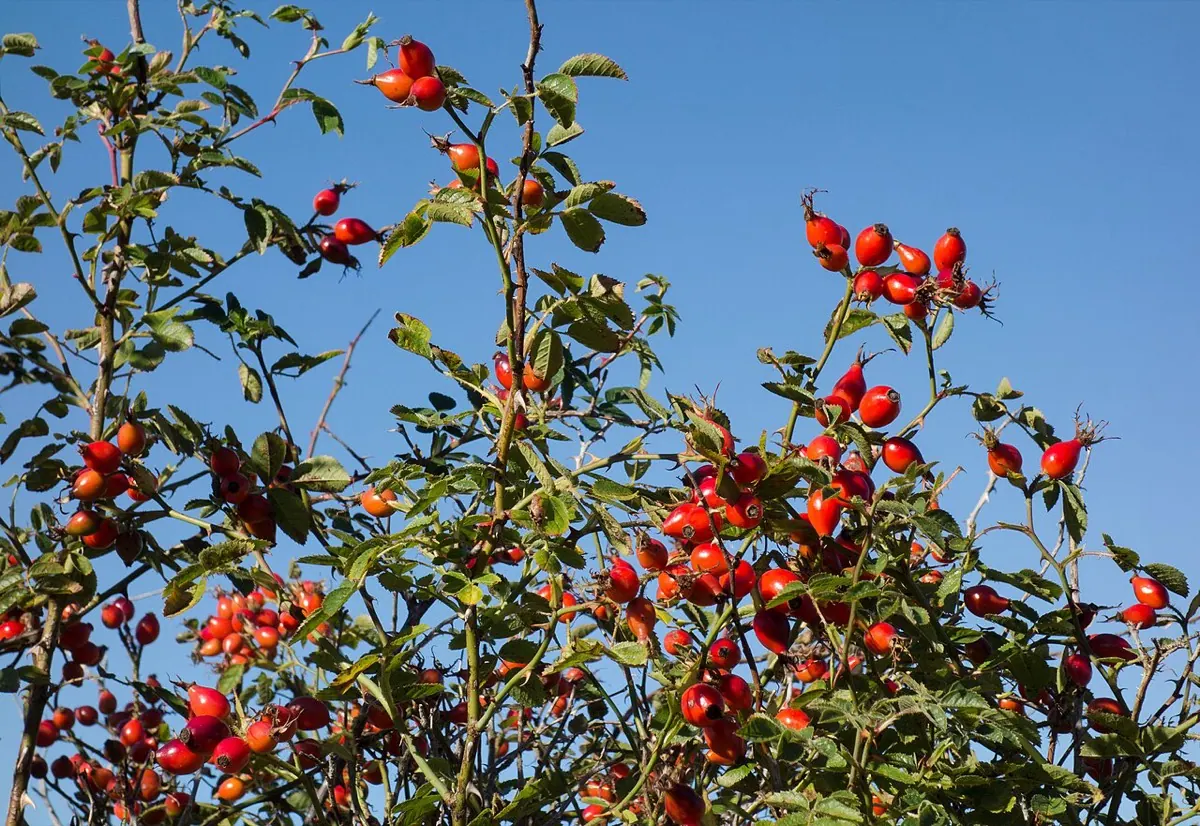
Photo: W.carter, CC0, Wikimedia Commons

Rose Hip
Rosa canina and other wild Rosa species
EdibleThe scarlet autumn fruit of the wild rose, one of the richest natural sources of vitamin C in Europe, and its irritant seed hairs are the only real hazard.
Confused with
Danger: None. Hawthorn fruit is also edible cooked.
How to tell: Haws grow on a small tree with lobed leaves and straight sharp thorns, and each haw contains one or two hard stones. A rose hip is on an arching cane with pinnate leaves and hooked thorns, and it is full of hairy seeds.
Danger: Toxic. Red shiny berries in the same autumn hedges cause violent burning and stomach upset, and the sap blisters skin.
How to tell: Bryony berries hang in long strings on a thin twining vine with glossy heart-shaped leaves and no thorns at all. Rose hips sit singly or in small groups on a thorny woody cane. If there are no thorns, it is not a rose.
Danger: Severely toxic. Clusters of red-orange berries on a bare fleshy spike at ground level have poisoned children.
How to tell: They sit on a naked upright stalk with no leaves, no thorns and no shrub. Nothing about them resembles a rose bush once you look.
Leaves
Alternate, pinnate, with 5 or 7 oval toothed leaflets 1.5-4 cm along a central stalk plus one at the tip. At the base of each leaf stalk sit two small leafy flaps (stipules) fused to the stalk, which is a reliable rose-family sign.
Flowers
Five broad pale pink to white petals, 4-6 cm across, with a boss of yellow stamens, faintly scented, in May and June. Five petals, always.
Stem
Green to red-brown arching canes armed with stout curved thorns that hook backwards like a cat claw, broad at the base and flattened. Not straight bristles.
Smell or taste
Flowers smell lightly sweet. Crushed leaves smell green and faintly of apple in some species. The cooked hip is confirmed safe and tastes tart, fruity and slightly floral.
Habitat
Hedgerows, woodland edges, scrub, abandoned terraces, roadside banks, mountain slopes. Widespread in northern and central Portugal and in the hills of the south.
Edible parts
The ripe hips, and the petals in early summer.
Preparation
Pick hips when fully red and just softening, traditionally after the first frost, which sweetens them. If there is no frost, as in much of Portugal, freeze them overnight instead, which does the same job. Inside every hip is a mass of seeds coated in fine stiff hairs. Those hairs irritate the gut and the skin badly, and they were once used as itching powder. Every method below exists to remove them, and straining through a proper cloth is not optional. Syrup, the standard preparation: top and tail 1 kg of hips, chop them roughly, drop them into 1.5 litres of boiling water, bring back to the boil and take off the heat for 15 minutes. Strain through a double muslin or a jelly bag and let it drip without squeezing. Return the pulp to 750 ml of fresh boiling water, stand 10 minutes, and strain again through fresh cloth. Combine the juices, reduce to about 750 ml, add 500 g of sugar, boil 5 minutes, bottle hot into sterilised bottles. Refrigerate after opening and use within a few weeks, or freeze in small portions. Do not boil hard for long stretches, since prolonged high heat destroys the vitamin C that is the whole point. For tea, dry halved deseeded hips in shade or at 50 C until hard, then use 1 to 2 teaspoons per 250 ml, simmered 10 minutes and strained through a fine cloth. To eat the flesh directly, halve each hip and scrape out every seed and hair with a small spoon, which is slow but makes a good puree or jam. Petals, picked in June, make a fragrant syrup or go into a salad; remove the bitter white heel at the base.
Traditional use
Rose hips were gathered by the ton for national syrup schemes in wartime Britain as a vitamin C source for children, and across Europe the hip tea is traditionally taken in winter for colds and the dried hip powder has a folk reputation for stiff and aching joints.
Harvest rule
Hips are key winter food for thrushes, blackbirds and fieldfares, so take a share from each bush and move on, and leave the highest fruit. Never cut or break canes, and never uproot a wild rose. Foraging law varies by country. In Portugal hedgerows and abandoned terraces usually have an owner, so ask, and inside ICNF national and natural parks check what collection is allowed. Some wild rose species are locally scarce; if a shrub is the only one for miles, leave it entirely.
Fruto da roseira-brava, agulheiro, silvamar (PT), escaramujo (ES), cynorhodon (FR)