 Human Skills
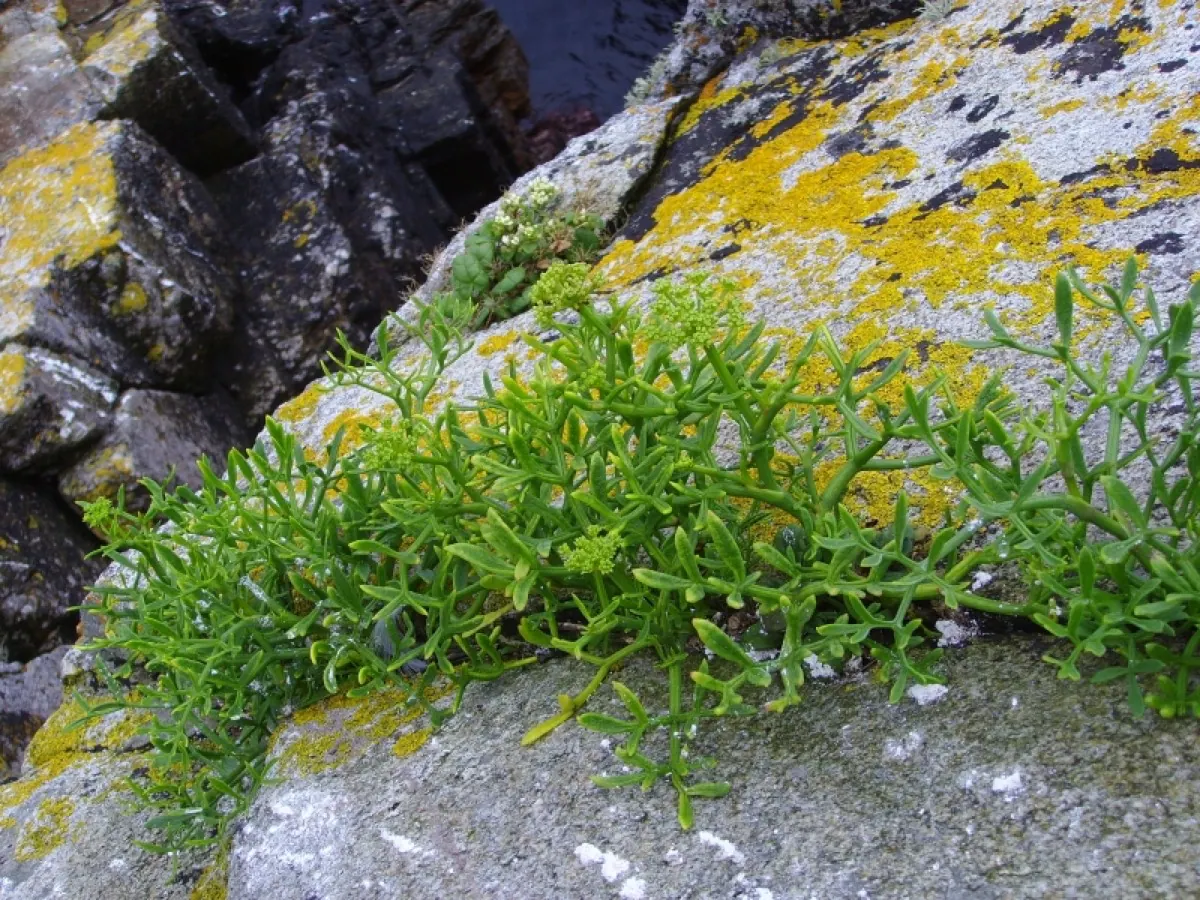
Photo: User:Jymm, Public domain, Wikimedia Commons

Samphire (Rock and Marsh)
Crithmum maritimum (rock samphire) and Salicornia europaea (marsh samphire)
EdibleTwo different coastal succulents share the name: rock samphire is an aromatic cliff plant in the carrot family, marsh samphire is a jointed leafless stem in the mud, and they are not interchangeable.
Confused with
Danger: Deadly. Rock samphire is in the carrot family and its umbel flowers sit it in the same visual group as the most poisonous plants in Europe, which grow on brackish banks close to the shore.
How to tell: Rock samphire is unmistakably succulent: its leaf segments are fat, cylindrical and blunt, not flat and toothed, and it grows out of bare rock and wall in salt spray, not in wet ground. Water-dropwort has flat toothed celery-like leaflets, a grooved hollow stem and it lives with its feet in fresh or brackish water. Because this is the carrot family, treat rock samphire as a plant you identify by its succulent leaves and its cliff habitat together, and never by the flower head alone.
Danger: None. Sea-blite is edible too.
How to tell: Sea-blite has small fleshy pointed leaves along the stem; marsh samphire has no leaves, only jointed segments. Both are eaten the same way.
Danger: Toxic and caustic. The latex burns the mouth and damages eyes. They are fleshy and coastal and grow close by.
How to tell: Snap a stem. Spurges bleed white milky latex. Neither samphire does. Do the break test every time.
Leaves
Rock samphire: alternate, fleshy, divided into thick blunt-tipped cylindrical segments 2-5 cm, blue-green and stiff, like a succulent version of a fennel leaf. Marsh samphire: no leaves at all, only opposite pairs of tiny scales at each joint of the stem.
Flowers
Rock samphire carries flat compound umbels 3-6 cm of tiny greenish-yellow to yellowish-white flowers from July to October, with a collar of narrow bracts underneath. Marsh samphire has almost invisible flowers sunk into the joints.
Stem
Rock samphire has a solid, ridged, woody-based branching stem, blue-green and hairless. Marsh samphire has a smooth, bright green, translucent, jointed and clearly segmented succulent stem that looks like a miniature cactus and snaps with a wet click, going red or yellow as the season ends.
Smell or taste
Rock samphire crushed smells strongly aromatic, resinous and polish-like, somewhere between carrot, celery and furniture varnish, which some people dislike. Marsh samphire has no smell at all and tastes purely of salt and green water. Once identified, both are confirmed safe.
Habitat
Rock samphire: sea cliffs, rocky shores, harbour walls, shingle, right in the salt spray, all along the Portuguese coast. Marsh samphire: bare tidal mud and the lower salt marsh of estuaries such as the Tejo, Sado and Ria Formosa, flooded twice a day.
Edible parts
Young shoots and leaves of both, picked before flowering.
Preparation
Marsh samphire is the simpler one. Cut the shoots with scissors 2 to 3 cm above the mud and never pull, because pulling brings the root and kills the annual before it seeds. Rinse hard in fresh water two or three times, since it grows in tidal mud and is full of grit. Steam or boil 2 to 4 minutes only and serve with butter and lemon; do not add salt, it is already salty. Eat the tender tips and pull the flesh off the woody inner core with your teeth on older stems. It is classic with fish and it pickles well in a boiled brine of equal white vinegar and water with a spoon of sugar, refrigerated. Rock samphire is aromatic and strong, so it is used as a condiment more than a vegetable. Pick young shoot tips before flowering. The traditional preparation, and the one that suits it, is pickling: blanch the shoots 1 minute, pack them into a jar, and cover with a boiled brine of 500 ml of cider vinegar, 250 ml of water, 30 g of salt and a teaspoon of peppercorns. Leave two weeks before eating and keep refrigerated. A small amount raw or blanched 2 minutes can go into a salad, but many people find the varnish note overwhelming in quantity. Neither dries well. Both freeze poorly. Pickle or eat fresh.
Traditional use
Rock samphire was gathered commercially from English and Portuguese cliffs and shipped in barrels of brine as a pickle, and its collection was dangerous enough to be mentioned in Shakespeare. It has no real folk-medicine tradition worth reporting beyond its value as a source of vitamin C for coastal and seagoing people.
Harvest rule
Cut, never pull, and take only the top third of any shoot so the plant regrows. Marsh samphire is an annual, so leaving plants to seed is what keeps the bed there next year. Both grow in the most heavily protected habitat in Portugal: the Tejo and Sado estuaries, the Ria Formosa and the Costa Vicentina are natural reserves and Rede Natura 2000 sites where ICNF rules restrict or prohibit plant collection, where commercial harvesting requires authorisation, and where salt marsh is critical feeding ground for wading birds. Check the rules for the specific site before you pick anything, keep out of bird roosting and feeding areas, and assume no collecting inside a nature reserve. Foraging law varies by country and coastal protection is usually the strictest of all.
Funcho-marinho, perrexil-do-mar (rock); salicornia (marsh) (PT), hinojo marino, salicornia (ES)