 Human Skills
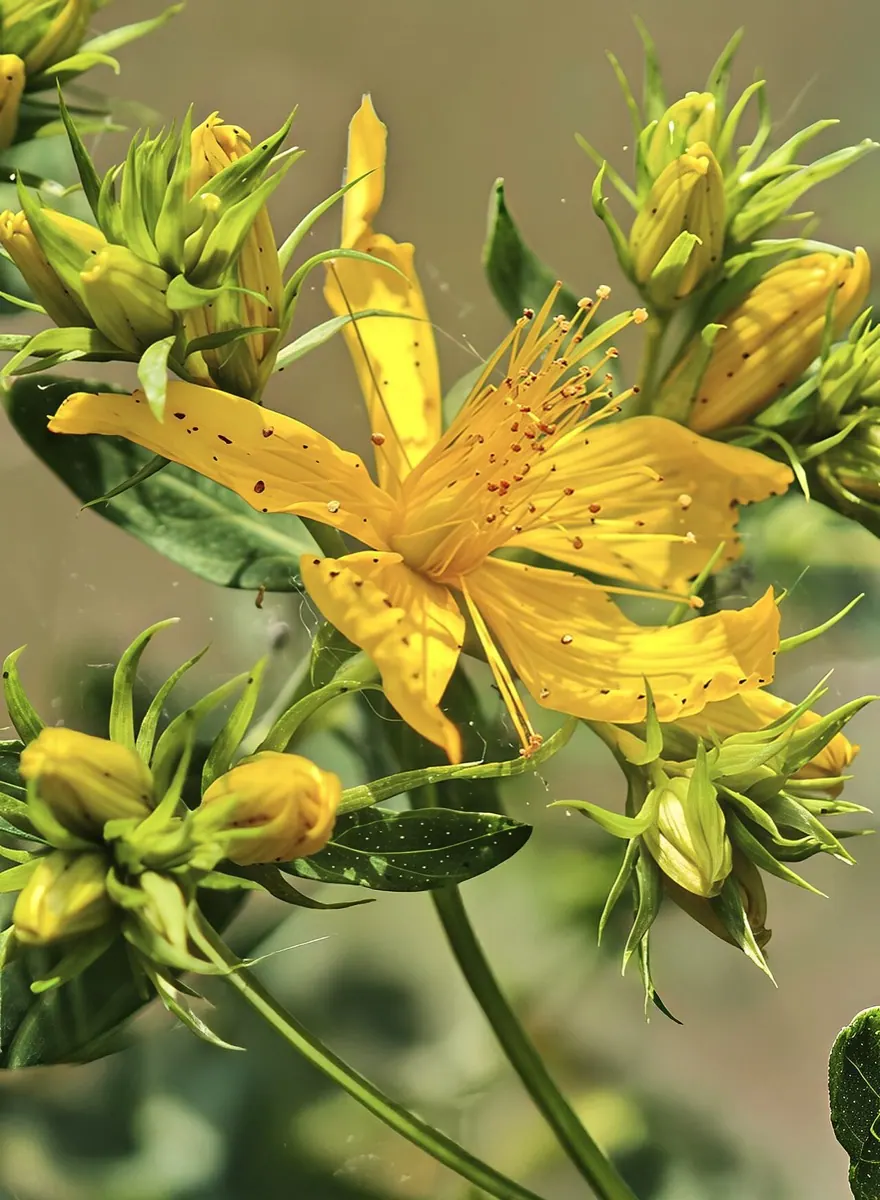
Photo: Didier Descouens, CC BY-SA 4.0, Wikimedia Commons

St John's Wort
Hypericum perforatum
A yellow midsummer flower with pinprick-perforated leaves and, more importantly, the worst drug interactions of any common herb in Europe.
Confused with
Danger: Not the traditional herb, differently constituted, and some have caused sickness in grazing livestock.
How to tell: Only H. perforatum has all three of: translucent pinhole dots through the leaf held to the light, two raised ridges on the stem, and flowers that stain fingers red. Tutsan has larger leaves without clear perforations and produces fleshy berries; Rose of Sharon is a low spreading shrub with very large flowers over 5 cm.
Danger: Genuinely dangerous. Ragworts contain pyrrolizidine alkaloids that cause cumulative, irreversible liver damage.
How to tell: Ragworts are daisy-family plants: each yellow flower is a composite head with a ring of separate strap-shaped rays around a button centre, and the leaves are deeply lobed and ragged, never with translucent pinholes. St John's wort has five simple petals, a mass of stamens, and perforated leaves.
Leaves
Opposite, stalkless, oblong, 1 to 3 cm long, clasping the stem in pairs. Hold one up to the light and it is scattered with translucent dots that look like pinholes; these are oil glands and they are the name-giving feature. The leaf edge often carries tiny black dots.
Flowers
Bright yellow, five petals, 1.5 to 2.5 cm across, in flat-topped clusters. The petals are often edged with tiny black dots. A mass of long yellow stamens stands out of the centre. Crush an open flower or a bud between your fingers and it stains them blood red or deep purple. That red stain plus the perforated leaf plus the two-ridged stem, together, confirm it.
Stem
Round but with two raised ridges or lines running down opposite sides along its whole length, which you can feel with a thumbnail. Hairless, solid, tough and woody at the base.
Smell or taste
Only faintly resinous when crushed, with no strong characteristic scent. Do not use taste for identification. Identify it by the perforated leaves, two-ridged stem and red-staining flowers.
Habitat
Dry grassland, roadside banks, open woodland edges, heath, abandoned fields and stony ground. Widespread in northern and central Portugal and throughout Europe.
Preparation
Traditionally the top 20 to 25 cm of the flowering stems are cut around midsummer, at or near St John's Day, when the flowers are fully open. They are dried in small loose bundles hung in a dark, airy place for one to two weeks, then crumbled and stored in a sealed dark jar. Infused oil is the classic external preparation: a jar is packed loosely with fresh flowering tops, covered completely with olive oil, sealed, and stood in the sun for three to six weeks until the oil turns deep red, then strained through cloth and stored in a dark bottle. This is the famous red oil of Portuguese and Mediterranean farmhouses. Any plant material poking above the oil will go mouldy, so keep everything submerged and discard the batch if it smells rancid. This guide deliberately gives no internal dose. St John's wort taken internally behaves like a drug, not like a cup of tea, and it belongs in a conversation with a doctor or pharmacist rather than in a kitchen jar.
Traditional use
Erva-de-são-joão is bound up with Midsummer across Europe: it was gathered on St John's night, hung over doorways, and steeped in oil to make the red oil rubbed on bruises, strains and burns in country households throughout Portugal and Spain. Taken internally it has a long European folk reputation as a herb for low spirits, which is why it has become one of the best-selling herbal products in the world. That popularity is exactly the problem. It is a potent plant with real, documented effects on how the body handles medicines, and it should be treated with the same seriousness as a prescription, not as an innocent tea.
Harvest rule
Cut only the flowering tops, leaving the lower stem and roots so the plant regrows, and take no more than one stem in five from a stand. In several regions it is a plant of conservation value in dry grassland, and in parts of the world it is a controlled invasive weed instead, so check which applies where you are. Ask the landowner's permission, avoid sprayed field edges and roadsides, and check local collecting rules, which vary by country and are strict in national parks and protected areas.
Hipericão, erva-de-são-joão, milfurada (PT); hierba de San Juan (ES)