 Human Skills
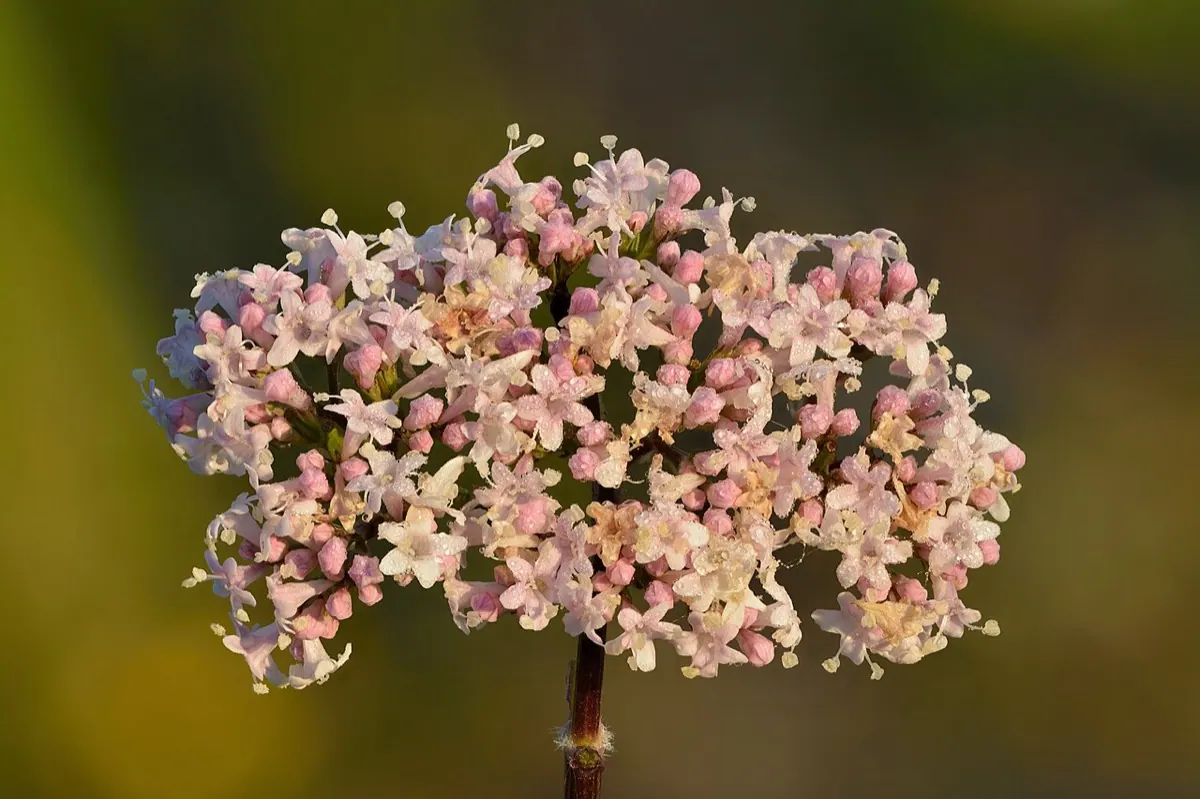
Photo: Ivar Leidus, CC BY-SA 4.0, Wikimedia Commons

Valerian
Valeriana officinalis
A tall damp-meadow plant with pale pink-white flower clusters and a root that smells powerfully of old socks, used as a sleep herb across Europe.
Confused with
Danger: Deadly. Hemlock paralyses the breathing muscles; hemlock water dropwort causes violent convulsions. Both grow in exactly the damp ground where valerian grows, and both have pinnate leaves and pale flower heads.
How to tell: Look at the flower head and the leaf arrangement. Umbellifers carry their flowers on an open umbrella of separate spokes radiating from one point, and their leaves are alternate. Valerian has a dense, domed, branched head with no spoke pattern, and its leaves are strictly in opposite pairs. If the leaves alternate up the stem, it is not valerian. Hemlock also has a purple-blotched hollow stem and a foul mousy smell.
Danger: Not dangerous, but it is a different plant with a different tradition and none of the same reputation.
How to tell: Red valerian has simple, undivided, blue-green oval leaves and bright crimson or deep pink flowers, and it grows in dry walls and rubble, not wet meadows. True valerian has divided pinnate leaves, blush-white flowers and damp ground.
Danger: Neither is deadly, but they are different plants, and hemp agrimony contains liver-damaging pyrrolizidine alkaloids and should not be taken internally.
How to tell: Meadowsweet leaves are alternate with small leaflets between large ones and are white-felted underneath, and it smells sweetly of almond. Hemp agrimony has leaves divided into three or five parts and dusty pink flowers. Neither has valerian's foul-smelling root.
Leaves
Opposite, pinnate, the whole leaf 10 to 25 cm long and divided into seven to twenty-five narrow lance-shaped leaflets arranged in pairs along a central stalk with one at the tip. Leaflets 2 to 8 cm, with a few coarse teeth, dark green above and paler below, slightly hairy.
Flowers
Tiny pale pink, blush or white tubular flowers, 4 to 5 mm, in a dense, domed, branched head 5 to 12 cm across at the top of the stem. The head has a faint sweet almond-like scent, quite unlike the root.
Stem
Single, stout, round with strong grooves running down it, hollow in the older lower part, usually hairy at the joints, unbranched until the flower head.
Smell or taste
The above-ground plant is mildly sweet. The dried root is the identifying feature and it is unforgettable: a strong, sour, cheesy, old-sock smell that fills a room. Cats react to it like catnip. Never use taste to identify anything in this family or any other.
Habitat
Damp meadows, ditches, stream banks, wet woodland edges and riverside grassland. Found in damp ground in northern and central Portugal and widespread across Europe.
Preparation
The root is the part used. It is lifted in autumn of the second year, after the plant dies back, washed hard to get the soil out of the fibrous mass, split, and dried slowly in a warm airy place, ideally below about 40 degrees Celsius, for one to three weeks until the pieces snap. The smell grows much stronger as it dries, so dry it somewhere you do not sit, and keep it away from cats, which will destroy the batch. Store dried root in a sealed dark jar, well labelled, for up to a year. The traditional preparation is a cold infusion of chopped dried root left in cold water overnight and strained, or a tincture made by steeping the root in alcohol for several weeks. This guide gives no dose for either. Valerian is a genuinely sedating plant, strength varies enormously between batches, and the amount belongs on a properly labelled pharmacy product or in a conversation with a pharmacist, not in a kitchen guess.
Traditional use
Valerian has been Europe's sleep and calming root since at least the Middle Ages, and it was widely used across the continent in the two World Wars for shattered nerves. In Portugal and Spain valeriana has traditionally been taken in the evening for a restless mind and a night of poor sleep, and as a calming preparation before a stressful day. It is one of the most widely sold herbal products in European pharmacies today. That is its history. It is not a treatment for insomnia or anxiety, and it is not a sleeping pill.
Harvest rule
Lifting the root kills the plant, so grow valerian in a damp corner and harvest your own second-year roots rather than digging wild ones. Wet meadow and riverside habitats are frequently protected in Europe, digging them damages far more than the one plant, and it is often illegal. Never dig without the landowner's explicit permission, never dig inside a national park or protected area, and check local rules, which vary by country. If you do take a wild root, take one plant from a large stand and leave the seed heads standing.
Valeriana, erva-dos-gatos (PT); valeriana (ES)