 Human Skills
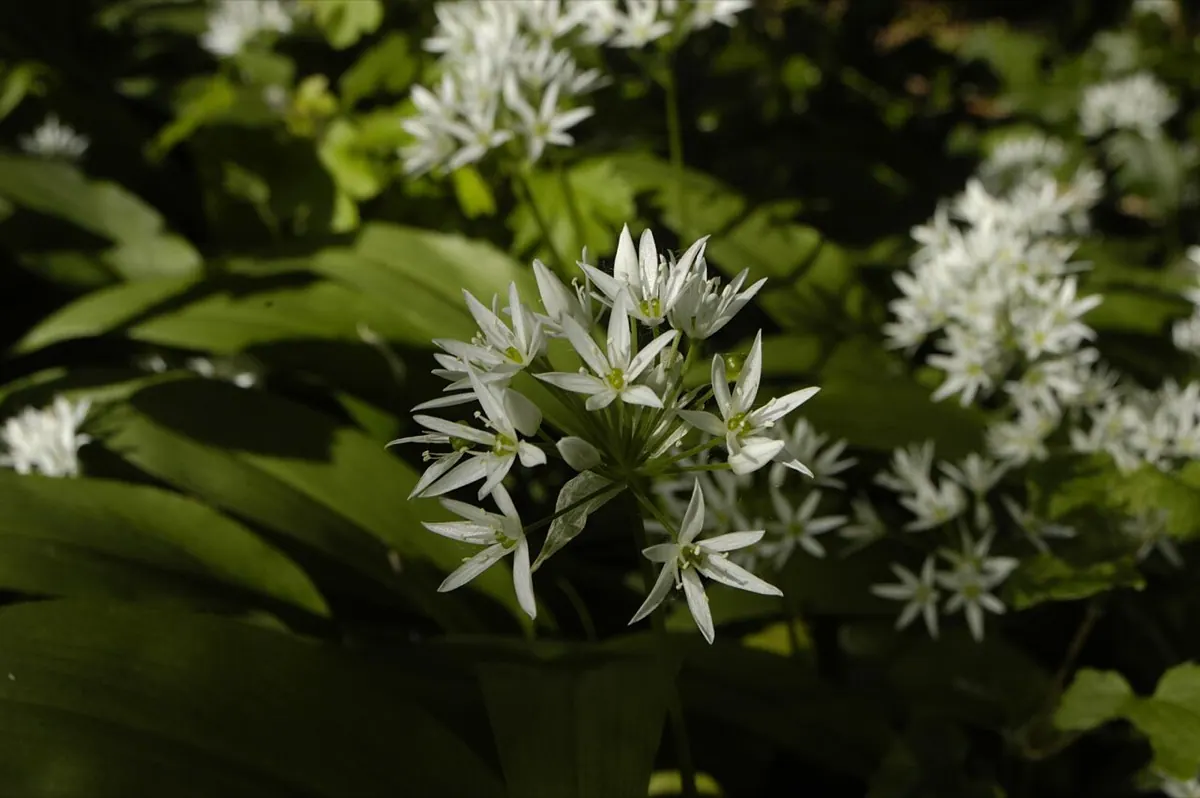
Photo: Rodolph, CC BY-SA 3.0, Wikimedia Commons

Wild Garlic (Ramsons)
Allium ursinum
EdibleSuperb spring green with three deadly lookalikes, so the rule is absolute: pick one leaf at a time, crush it, and if it does not smell of garlic it does not go in the bag.
Confused with
Danger: Deadly. Colchicine poisoning starts with burning in the mouth and violent vomiting and diarrhoea hours later, then multi-organ failure over days. There is no antidote and a few leaves can kill an adult. Deaths in Europe are usually people who thought they had wild garlic.
How to tell: Colchicum leaves have no garlic smell whatsoever when crushed, and this is the only test that matters. They also grow in several leaves clasping and sheathing one another from a single point at ground level, thick, stiff, shiny and hairless, in open meadows and grassland rather than woodland carpet, and they appear in spring with no flower, since it flowers naked in autumn. Crush every single leaf. If it does not smell of garlic, do not pick it, and if your hands already smell, wash them and start again.
Danger: Deadly. Contains cardiac glycosides. Causes vomiting, blurred vision, a slow or chaotic heartbeat and cardiac arrest. Every part is toxic, including the berries.
How to tell: No garlic smell when crushed. Its leaves come in twos or threes wrapped around one another from a shared base sheath, and they are stiffer, glossier and darker than wild garlic, with the leaf stalks sheathed together rather than each leaf arising separately from the soil. The flowers are hanging white bells on one side of an arching stalk, not a flat head of open stars. It grows in the same shady woodland and is the most likely mistake for an experienced forager going too fast.
Danger: Severely toxic and potentially fatal by airway obstruction. Needle-like oxalate crystals cause instant violent burning and swelling of the mouth, tongue and throat. Arum italicum is common in Portugal.
How to tell: No garlic smell. Arum leaves are arrow or spear shaped with two backward-pointing lobes at the base, thick and glossy, and clearly net-veined with veins branching out from a central midrib. Wild garlic leaves have parallel lengthwise veins and no basal lobes. Arum often pushes up in the same woodland at the same time.
Danger: None. It is edible and abundant in Portugal.
How to tell: Also smells of garlic, but its leaves are narrow and keeled with a ridge underneath, and its flowers are hanging white bells with a green stripe on each petal.
Leaves
Each leaf rises separately straight from the ground on its own stalk, never in a pair or whorl on a stem. Blade broad and lance-shaped, 10-25 cm long and 3-7 cm wide, pointed, soft, matt to slightly glossy, bright green, with fine veins running lengthways parallel and no net veining. The leaf stalk twists so the blade often lies at an angle.
Flowers
A loose flat-topped umbel of 6 to 20 pure white star flowers, each with six pointed separate petals, sitting on top of the triangular stalk. They open in April and May and smell faintly of garlic.
Stem
The flowering stalk is smooth, three-angled in cross-section (feel the three edges by rolling it between finger and thumb) and leafless, rising 20-45 cm from the bulb.
Smell or taste
Crush one leaf between your fingers. It must smell unmistakably and strongly of garlic. This is the identification. Note the trap: once your hands smell of garlic every leaf will seem to, so crush each new leaf with a clean fingernail or check your hands are washed. Never use taste to identify: the deadly lookalikes can poison you in mouthful amounts.
Habitat
Damp, shaded deciduous woodland on rich soil, stream sides and shaded valleys, in carpets. In Portugal it is restricted to cool damp northern woodland such as Geres and the Serra da Estrela foothills; in most of central and southern Portugal you will meet three-cornered leek instead.
Edible parts
Leaves, flower buds, open flowers and the green seed pods. Leave the bulbs.
Preparation
Pick leaves one at a time, crushing and smelling each one before it goes in the bag, and pick before flowering for the best leaf. Cut with scissors above ground level and never pull the bulb. Use raw in small amounts: shredded into salad, or as pesto, which is the classic. For pesto, blend 100 g of leaves, 50 g of toasted nuts, 50 g of hard cheese, 120 ml of olive oil and a good pinch of salt. It keeps refrigerated under a film of oil for about a week. Wilted into soup, potatoes or scrambled eggs it loses most of its punch in 2 minutes, so add it at the end. Leaves can be salted down like a preserved herb: layer chopped leaf with 15 g of salt per 100 g in a jar. Do not store wild garlic in oil at room temperature, since low-acid herbs in oil are a botulism risk; keep any oil preparation refrigerated and use it within a week, or freeze it. Green seed pods, picked in June while still soft, pickle well in a boiled brine of equal vinegar and water with 30 g of salt per litre.
Traditional use
Traditionally eaten across northern Europe as a spring cleansing food and used in folk practice much as cultivated garlic was, for circulation and for winter chestiness. Any claims beyond that are folklore, not evidence.
Harvest rule
Never dig the bulbs: the carpet takes years to rebuild and in many countries uprooting wild plants is illegal. Take one or two leaves per plant across a wide area, never more than a third of a patch, and leave flowering plants alone. Wild garlic is scarce and locally protected in parts of southern Europe, and in Portugal it is a northern woodland plant at the edge of its range, so treat it as precious. Foraging law varies by country: inside Portuguese national and natural parks and Rede Natura sites, ICNF rules may forbid collection entirely, and commercial gathering normally requires authorisation. Always ask on private land.
Alho-ursino, alho-dos-ursos (PT), ajo de oso (ES), ail des ours (FR)