 Human Skills
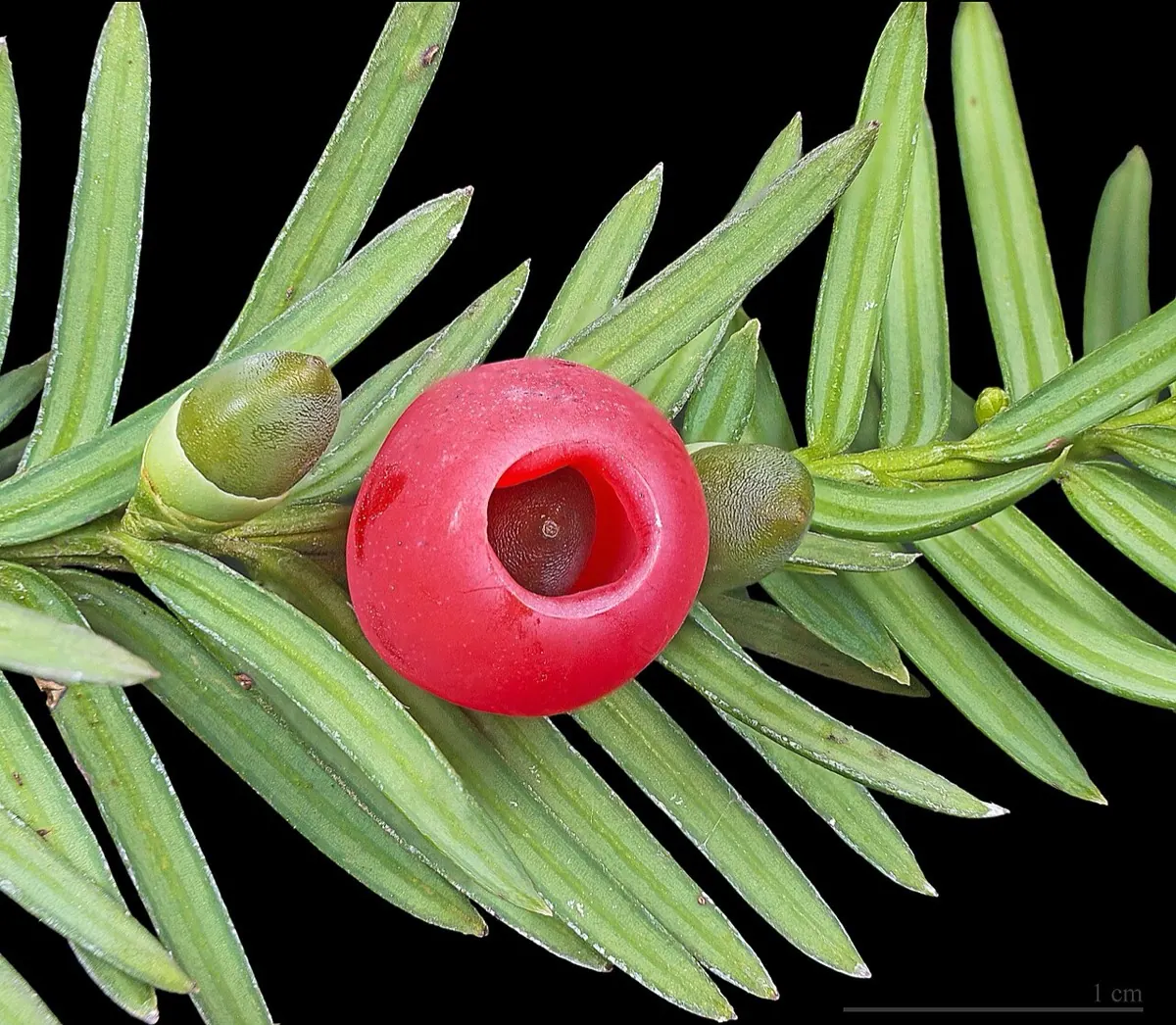
Photo: Didier Descouens, CC BY-SA 4.0, Wikimedia Commons

Yew
Taxus baccata
PoisonousEvery part but the red flesh of the berry stops the heart, often with no warning symptoms at all.
Confused with
Danger: Taxine alkaloids cause a chaotic then failing heartbeat. Collapse can come suddenly with few earlier symptoms, sometimes hours after eating, and there is no antidote. A handful of needles has killed adults.
How to tell: Turn a needle over. Edible conifer needles for tea, such as pine, have needles in bundles of two to five held by a papery sheath, and fir has two bright chalk-white stripes on the underside. Yew needles come singly in two flat rows, with a dull pale green underside and no white stripes. No white stripes and no bundle means do not brew it.
Danger: The red flesh alone is harmless, but the seed inside it is lethal, and children swallow both. Chewed seeds kill.
How to tell: A yew aril is an open-ended red cup with a hard dark seed visible at the tip, growing on an evergreen with flat needles. No edible berry looks like that. Teach children that red berries on a needle tree are never food.
Leaves
Flat needles 1 to 3 cm long and 2 to 3 mm wide, dark glossy green above, paler matt green beneath with two dull bands and no bright white stripes, soft-pointed not sharp, arranged in two flat rows either side of the twig like a feather.
Flowers
No true flowers. Small pale male cones shed clouds of pollen in late winter. Female trees carry a single hard dark seed sitting in a soft bright red open-ended cup called an aril, like a little red olive with the seed showing at the end.
Stem
Reddish-brown bark that flakes in thin papery scales, and green twigs. The wood, the bark, the needles and the seed are all poisonous, fresh or dried.
Smell or taste
Crushed needles smell faintly resinous and bitter. The red aril flesh is sweet, which is why children eat the berries whole and swallow the deadly seed. Never taste any part.
Habitat
Churchyards, old gardens, hedges, limestone woodland, mountain slopes and formal planting. Widespread in Portugal in gardens and cemeteries, native in the Serra da Estrela and northern mountains.
Preparation
There is no preparation that makes yew safe. Drying does not reduce the toxin, and dried clippings are actually the classic cause of livestock deaths. Never make needle tea, never use the wood for skewers, spits or cooking fuel, and never use the bark for anything internal.
Traditional use
Yew bark and needles are the origin of paclitaxel and docetaxel, real chemotherapy drugs. Those compounds are semi-synthesised, purified and dosed by the milligram in hospital under laboratory control. The raw plant is simply a heart poison. Any attempt to extract or dose it at home is lethal.
Harvest rule
Nothing is harvested from yew for food or medicine. When clipping, wear gloves and eye protection, sheet up the clippings and take every scrap to a green waste facility. Never leave clippings in or near a paddock, field edge or poultry run, and never burn them where people are standing. Old churchyard and veteran yews are often legally protected and thousands of years of growth sit in some of them, so get permission before cutting anything on old trees.
Teixo (PT); yew, English yew (EN)