Human Skills
Growing With Almost No Water
Dry farming, spacing and the yield it costs
6 minIntermediateUpdated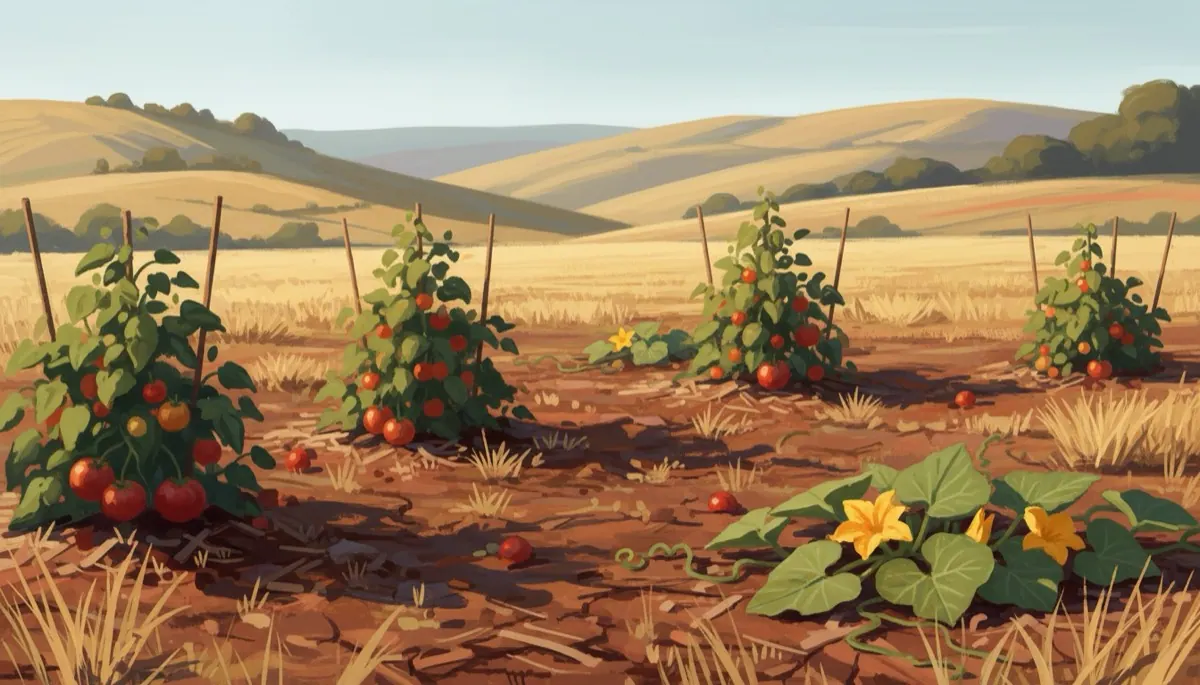
- Explain how stored winter moisture carries a summer crop
- Use spacing, mulch and variety choice instead of irrigation
- State honestly what dry farming costs in yield
The principle
Dry farming means growing a summer crop on water stored in the soil from winter rain, with little or no irrigation. It works where winter rainfall is at least 400 to 500 mm and the soil is deep enough to bank it, ideally a metre or more of loam or clay loam, which can hold 150 to 200 mm of available water per metre of depth. Sandy soil holds only 60 to 90 mm per metre and cannot do it. The job then is to keep that bank from leaking: cover the surface, stop weeds drinking it, and space plants so each has enough soil volume to itself. Roots go down 1.5 to 2 metres in a dry-farmed tomato, against 40 cm in an irrigated one.
Deep mulch and dust mulch
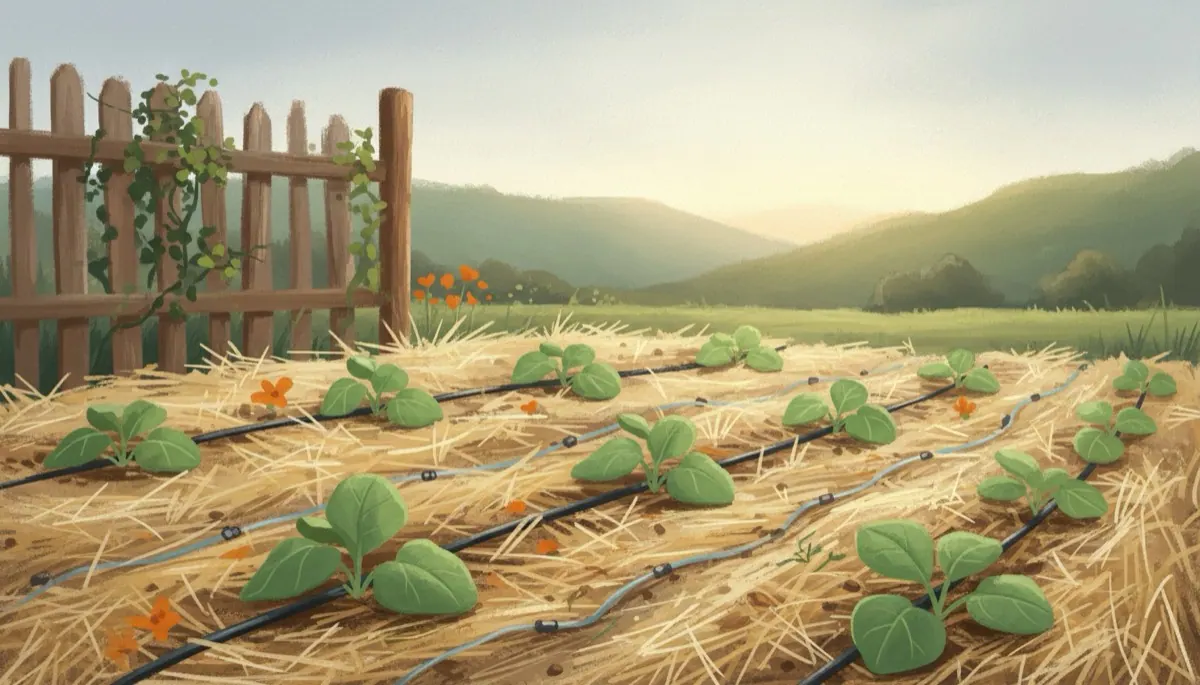
Organic mulch is the first defence: 7 to 10 cm of straw, leaves or spoilt hay cuts evaporation from bare soil by 50 to 70 percent and keeps the surface temperature 5 to 10 degrees lower. Apply it in spring while the soil is still full, not in July when it is empty. Dust mulch is the old dryland alternative where mulch material is scarce: shallow hoeing of the top 3 to 5 cm after each rain, which breaks the capillary channels that wick water to the surface and lets a dry loose layer act as a cap. It works, it is what Alentejo farmers did for centuries, and it must stay shallow, because hoeing deeper cuts the very roots you are protecting. Never dust mulch on a slope where wind and rain will take the loose layer away.
Wide spacing and no weeds
Every plant needs a private reservoir. Dry-farmed tomatoes go 1.2 to 1.8 metres apart instead of the usual 45 to 60 cm; melons and squash 2 to 3 metres; maize goes in widely spaced hills rather than dense rows; vines traditionally sit 1.5 to 2.5 metres apart on unirrigated hillsides. Plant deep, into moist soil, and plant early so roots are down before the heat. Weeds are not a tidiness question here, they are direct competitors drinking the same bank, and a weedy dry-farmed bed will fail. Keep the ground clean within the whole spacing circle, not just around the stem. Do not interplant or squeeze in a catch crop; density is exactly the thing you are trading away.
Varieties that can take it
Choose open-pollinated, locally adapted, often older varieties with deep roots and small leaves. For tomatoes, the dry-farm classic is Early Girl, along with many Italian and Iberian paste types. Melons and watermelons are naturally deep rooted and dry farm well. Figs, olives, almonds, grapes, pomegranates and carob are all grown in Portugal with no summer water once established, typically after two or three years of support watering. Beans such as fava and chickpea are winter and spring crops that finish before the drought. Avoid modern high-yield hybrids bred for irrigation, and avoid lettuce, celery, cucumber and anything shallow rooted, which simply cannot be dry farmed.
What it costs
Be clear-eyed. Dry-farmed tomatoes typically yield 30 to 50 percent less per plant than irrigated ones, and because spacing is two to three times wider, yield per square metre can be a quarter to a half of an irrigated bed. Fruit is smaller. In exchange, flavour and dry-matter concentration are markedly better, which is why dry-farmed tomatoes and wine grapes command a premium, and the crop costs no water, no pumps and no pipe. The honest way to use it: dry farm the crops that repay it, tomatoes for sauce, melons, squash, vines and trees, and spend your limited water on the shallow-rooted salad and leaf crops that cannot survive without it. That combination feeds a household on far less water than irrigating everything.
Check yourself
It relies on a deep soil banking winter rain, around 150 to 200 mm of available water per metre in loam, which the crop draws on all summer.
Wide spacing gives each plant a private soil reservoir, which is the whole basis of the technique.
Only the top 3 to 5 cm, enough to break the capillary channels; hoeing deeper cuts the roots you are trying to protect.
Yield per plant drops 30 to 50 percent and wide spacing cuts yield per square metre further, in exchange for much better flavour and no water use.
Try it for real: Dry farm one bed this season
- Pick your deepest, heaviest soil and dig a hole in March to check it is moist at 60 cm
- Plant four tomatoes or two melons at 1.5 metres apart, deep, and water them in once at planting
- Mulch 10 cm deep with straw or leaves across the whole spacing circle
- Keep the bed completely weed free and do not water again unless plants wilt at 8 am
- Weigh the harvest and compare it with an irrigated plant of the same variety
🛒 Gear for this skill
As an Amazon Associate I earn from qualifying purchases. It costs you nothing extra and keeps this site free.
Next lesson: Storing and Stretching Water →
Written and checked by the Human Skills team against the sources below. How we check our content
- FAO Crop Yield Response to Water
- University of California Agriculture and Natural Resources Dry Farming
- RHS Drought Resistant Gardening