 Human Skills
Growing Grain by Hand
The area, the threshing and why most people buy flour
6 minIntermediateUpdated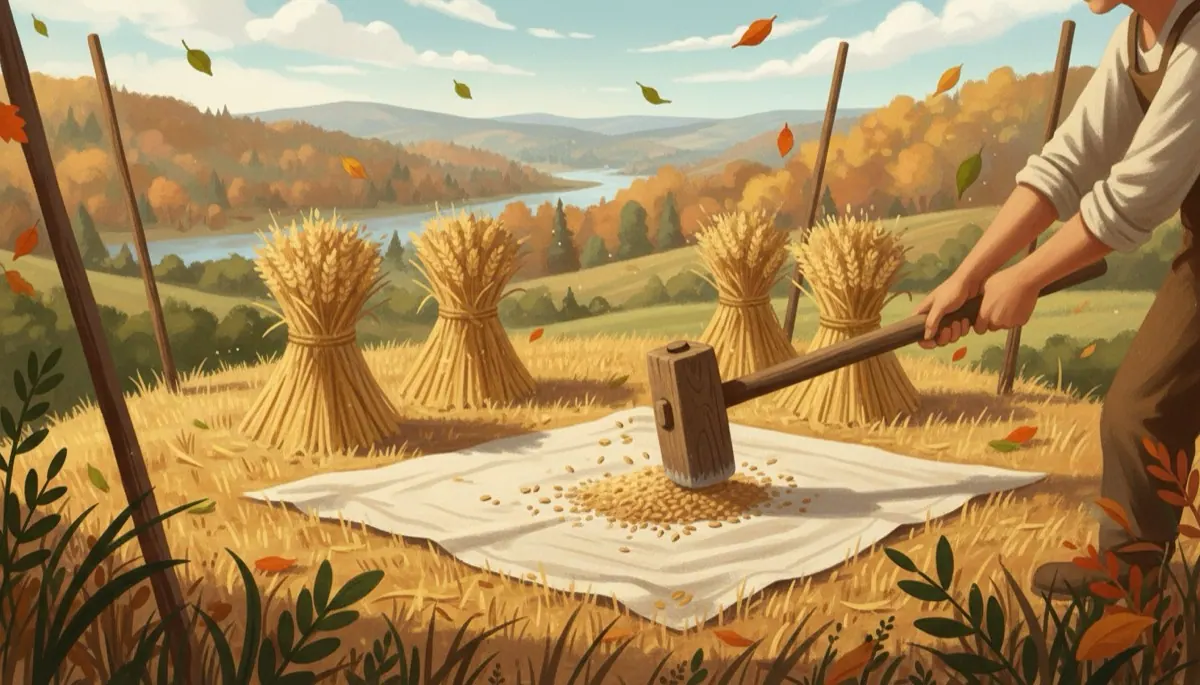
- Calculate the area needed for a year of bread
- Harvest, thresh and winnow a small grain crop
- Store grain safely against weevils and damp
The area for a year of bread
Wheat at household scale, hand sown and hand harvested, gives roughly 0.3 to 0.4 kg of grain per square metre. A kilogram of wheat makes about 0.75 kg of flour, and a standard 800 g loaf takes around 500 g of flour.
If one person eats half a loaf a day, that is about 90 kg of flour a year, so roughly 120 kg of grain, so somewhere between 300 and 400 square metres. For a family of four you are looking at well over a thousand square metres, which is a field rather than a garden.
Growing it is the easy part. You sow in autumn, it needs no watering in most of Europe, and it largely looks after itself until July.
Cutting and drying
Harvest when the straw is golden, the ears hang over and a grain squashed between your teeth is hard rather than doughy. Too early and it will not keep. Too late and the ears shatter as you touch them.
Cut with a sickle or a scythe, a handful at a time, low enough to get useful straw. Tie into sheaves about as thick as your forearm and stand eight or ten of them together in a stook, ears up, so wind passes through. Leave them a week or two in dry weather to finish ripening and drying.
In a wet climate move the sheaves under cover instead. Damp grain in a sack heats, moulds and is then fit for nothing.
Threshing and winnowing
Threshing is knocking the grain out of the ear. At small scale you beat the sheaves against the inside of a clean barrel, or lay them on a sheet and hit them with a flail or a stick. It is loud, dusty and slower than you expect: budget an hour of work for roughly 10 to 15 kg of grain, and wear a dust mask.
Winnowing separates grain from chaff using the wind. Pour the mixture slowly from one bucket into another on a breezy day, or in front of a fan. The heavy grain drops, the light chaff blows away. Repeat three or four times until the grain is clean.
This is the step that ended most people's grain growing, and it is why village threshing floors were shared.
Storing grain that lasts
Grain must be down to about 13 to 14 percent moisture or it will heat and mould. The rough test is that a grain shatters under a hammer rather than flattening, and that you cannot dent it with a fingernail.
Store it in sealed metal or food grade plastic containers, not paper sacks, in a cool dry place. Grain weevils arrive in the crop itself, so many smallholders freeze each container for 72 hours before sealing it, or fill the headspace with carbon dioxide. Bay leaves in the container are traditional and only mildly effective.
Check monthly for warmth, webbing or a sweet musty smell. Clean grain kept cool and sealed holds two years or more, and ground flour only a few months, so mill as you need it.
Why most smallholders buy grain
Wheat is cheap, keeps well, is easy to buy in 25 kg sacks and takes a third of an acre and several days of labour to produce for one person. Almost every other crop you could put on that ground returns more food for less work.
The sensible decision for most households is to buy flour or whole grain and spend the land on potatoes, beans, squash and trees. That is not giving up. Even traditional Portuguese smallholdings grew maize for the household and bought or traded for wheat.
Grow a small patch anyway if you want to learn it. Twenty square metres will teach you the whole process, give you about 7 kg of grain, and let you decide with real experience whether a field is worth it.
Check yourself
At about 0.35 kg per square metre you need roughly 120 kg of grain, which is 300 to 400 square metres.
Winnowing pours the threshed mixture through a breeze so the light chaff blows away and the heavy grain falls.
Above roughly 14 percent grain heats and moulds in store. A dry grain shatters rather than flattens under a hammer.
Grain is land hungry and labour heavy to process, while being one of the cheapest things you can buy.
Try it for real: Grow and thresh a test patch
- Sow 10 to 20 square metres of wheat, rye or barley in autumn.
- Cut it when the ears hang and the grain is hard, and stook it to dry.
- Thresh it in a barrel or on a sheet, wearing a dust mask.
- Winnow it in a light breeze until the grain runs clean.
- Weigh the result and work out what a year of bread would really cost you in land.
🛒 Gear for this skill
As an Amazon Associate I earn from qualifying purchases. It costs you nothing extra and keeps this site free.
Next lesson: Seed Independence →
Written and checked by the Human Skills team against the sources below. How we check our content
- FAO Handling and Storage of Food Grains
- Kansas State University Extension, Stored Grain Management
- John Jeavons, How to Grow More Vegetables
Related lessons
Crop Rotation and Planning a Year of Food
Move plant families, fill every gap, eat all year
How Much Land Feeds One Person
The honest arithmetic behind a number everyone gets wrong
Why Salad Does Not Feed You
The staple four, and the hard problem of fat
Planning a Year of Eating
Work backwards from the kitchen, not forwards from the seed box