Human Skills
Keeping Food Without Electricity
Root cellars, clamps and cool larders
5 minIntermediateUpdated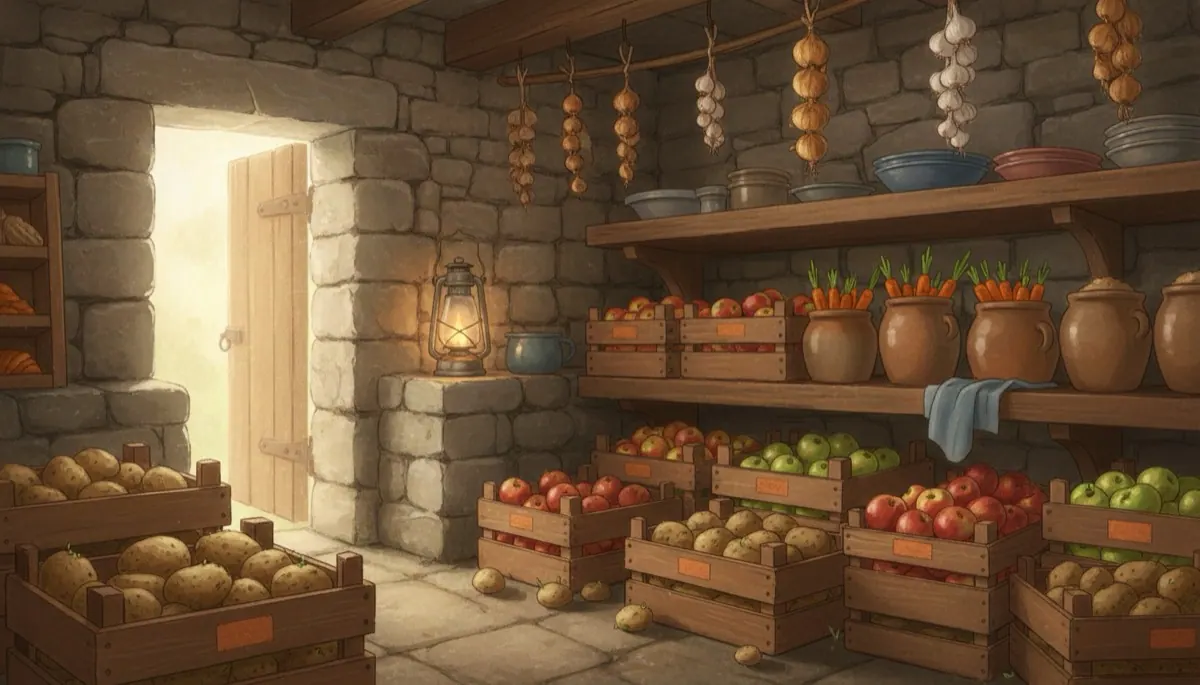
- Hit the right temperature and humidity for each crop group
- Build a clamp or a cool larder with what you have
- Rotate stores so nothing rots unseen
What makes a root cellar work
A root cellar is simply a space that stays cold, dark, humid and ventilated. The target for most roots is 0 to 4 degrees Celsius at 90 to 95 percent humidity. Below about 1.5 metres, soil temperature barely moves through the year, which is why cellars are dug in or built into a bank. You need two vents, one low to let cold air in and one high to let warm damp air out, and both screened against rodents. Keep it dark, because light makes potatoes green and sprout, and keep it free of a heat source, which includes a boiler on the other side of the wall.
Clamps, the cellar you dig in a day
A clamp stores roots outdoors with no building. Pick a well-drained spot, lay 15 cm of dry straw on the ground, pile cured potatoes, carrots, beetroot or turnips into a cone, cover with another 20 cm of straw, then 15 cm of soil dug from a drainage trench all around, leaving a small straw chimney at the top for ventilation. It holds for months in a mild winter and costs nothing. The catch is that opening it in wet weather half-ruins it, so build several small clamps rather than one big one and open one at a time.
Cool larders and evaporative coolers
Where you cannot dig, a north-facing larder with a vent to outside, stone or tile shelves and a mesh screen on the window will run several degrees below the house. It suits eggs, hard cheese, cured meat, oils and jars rather than roots. In dry heat, evaporation is free cooling: a pot-in-pot cooler, wet sand between two unglazed clay pots under a damp cloth, can hold 10 to 15 degrees below ambient and keeps greens and tomatoes usable for days. It only works where air is dry and moving, so it is far less effective in humid weather.
Every crop wants something different
Potatoes: 4 to 7 degrees Celsius, high humidity, total darkness; colder than that turns starch to sugar. Carrots, beetroot and turnips: 0 to 2 degrees and very humid, ideally packed in barely damp sand. Onions and garlic: 0 to 5 degrees but dry, around 60 to 70 percent humidity, hung in nets with good air movement. Squash and pumpkin: warm and dry, 10 to 15 degrees, never the cellar. Apples: cold and humid but stored apart from everything else, because the ethylene they give off sprouts potatoes and makes carrots bitter. Cabbage keeps well but smells, so give it its own corner.
Rotation and inspection
Stores fail quietly. Label everything with the month it went in, put the oldest at the front, and walk the store once a week with a torch, taking out anything soft, sprouting or smelling wrong before it infects its neighbours. Keep a simple written list on the door of what is in there and roughly how much, so you eat down the crops that keep badly first and save the good keepers for late winter. Store nothing in sealed plastic, which sweats and rots. Crates, hessian, nets and sand all let the crop breathe.
Check yourself
Alliums want cool but dry air, around 60 to 70 percent humidity, hung in nets. Damp storage rots them quickly.
Apples give off ethylene gas, which triggers sprouting and off-flavours in stored roots. Separate rooms or sealed crates solve it.
Low and high vents create airflow that carries away warm damp air and ethylene, and darkness stops potatoes greening.
One damaged root rots and spreads through the pile. Clamp only sound, cured, unwashed roots, and build several small clamps.
Try it for real: Find the cold corner of your home
- Put a thermometer and hygrometer in three candidate spots for a week
- Record the coldest and most humid, and the coolest dry spot
- Store one crate of roots in damp sand and one net of onions dry
- Label both with the date and set a weekly torch inspection
- Write down what failed after one month and why
🛒 Gear for this skill
As an Amazon Associate I earn from qualifying purchases. It costs you nothing extra and keeps this site free.
Next lesson: Essential Hand Tools →
Written and checked by the Human Skills team against the sources below. How we check our content
- FAO Manual on Rural Home Techniques of Food Storage
- USDA Complete Guide to Home Canning
- US EPA Indoor Air Quality guidance