Human Skills
Roots All Year
Carrots, beetroot, turnip and radish in succession
5 minIntermediateUpdated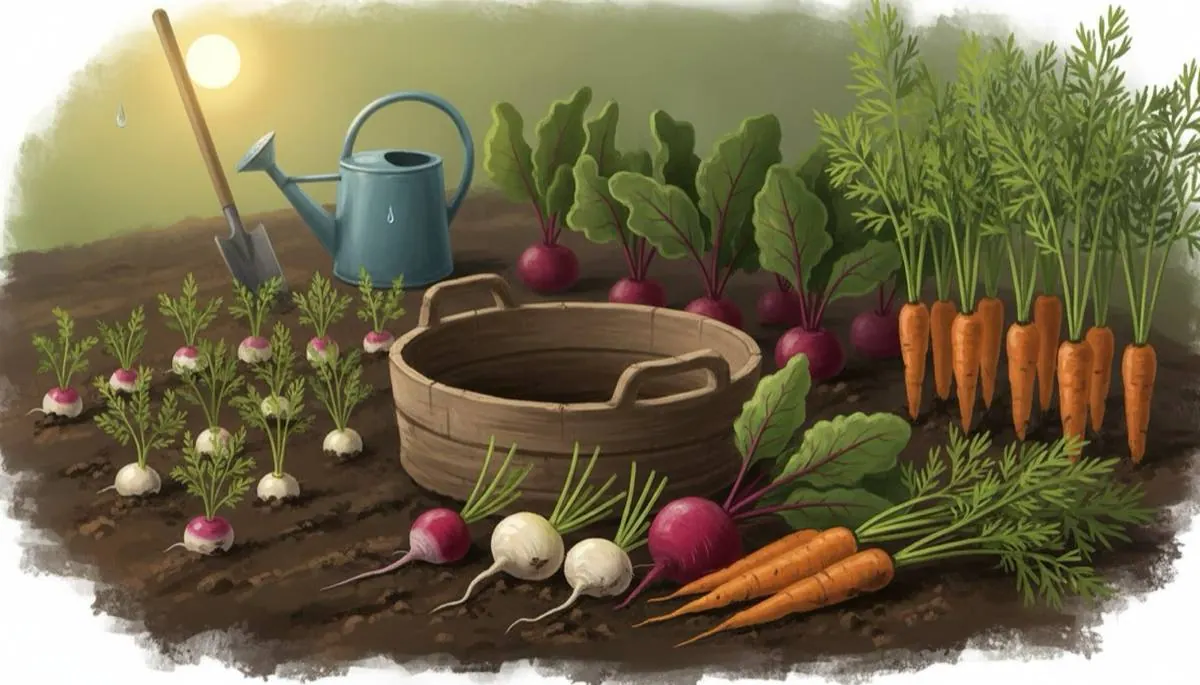
- Set up a successional sowing rhythm every two to three weeks
- Thin roots properly and know why forked roots happen
- Store roots in sand or leave them in the ground safely
Sow little and often
Roots do not wait politely. A whole packet sown at once gives you thirty carrots in the same week and none the next month. Instead sow a short row every two to three weeks through the season: radish matures in 25 to 30 days, turnip in 45 to 60, beetroot in 55 to 70, carrots in 70 to 110 depending on type. A rough rule is to sow the next row when the last one has its first true leaves. Stop sowing about ten to twelve weeks before your first frost for anything you want to harvest, or keep going with fast radish and turnip until six weeks before.
Direct sow and never transplant
Roots resent root disturbance, so sow where they will grow. Rake a fine seedbed with no clods, make a drill 1 to 2 cm deep, water the bottom of the drill rather than the surface afterwards, sow thinly, cover and firm. Carrots need soil at 7 degrees Celsius or more and can take two to three weeks to appear. Beetroot seed is a cluster of several seeds, so expect a small clump from each one. Radish germinates in four days and makes a good marker row. Soil crusting after heavy rain stops germination: a light scatter of sieved compost over the drill prevents it.
Thinning, and doing it right
Thinning feels wasteful and is not optional. Crowded roots stay pencil thin. Thin carrots to 4 to 5 cm apart, beetroot to 8 to 10 cm, turnip to 10 cm, radish to 3 cm. Do it in two passes: once at the first true leaf and again two weeks later, eating the second thinnings. Thin on a dull still evening and water afterwards, because the smell of bruised foliage is what draws carrot root fly from up to a kilometre away. Remove every thinning from the plot rather than dropping it on the bed, and firm the soil back around the plants you keep.
Why roots fork and split
A forked carrot met an obstacle: a stone, a clod, or a lump of fresh manure. Never grow roots on ground manured that season. Grow them in the year after a heavy feeder instead, and on stony ground grow short stump-rooted varieties or use a deep container. Splitting comes from a sudden soak after a dry spell, so water steadily rather than in bursts. Hairy roots with lots of side rootlets mean too much nitrogen. Woody, bitter beetroot means the crop stayed too long in hot dry soil. Small pale carrots usually mean too much shade or too little thinning.
Winter roots, in the ground or in sand
In mild winters you can leave carrots, beetroot, turnip and parsnip in the ground and lift as needed, under 15 cm of straw or leaves to keep the soil workable and sweeten the flavour after frost. Where the ground freezes solid, or where slugs and rodents are heavy, lift instead. Twist off the tops to 2 cm rather than cutting, discard anything damaged, and layer the roots in a box of barely damp sand or sawdust so they do not touch. Keep at 0 to 5 degrees Celsius in a shed or garage. Good roots keep four to six months this way.
Check yourself
Successional sowing every two to three weeks spreads the harvest instead of giving one glut.
The growing tip splits when it hits an obstacle or a pocket of fresh manure, so grow roots on stone-free, unmanured ground.
Carrot root fly finds the crop by scent from a long distance, so minimise and remove crushed foliage.
Damp sand keeps them from drying out and stops them touching, so one rot does not spread.
Try it for real: Start a succession rhythm
- Mark a metre of bed and sow one short row of carrots and one of radish
- Put a repeating reminder in your phone for every two weeks
- Thin at the first true leaf and again two weeks later, removing thinnings
- Water steadily rather than in bursts to avoid splitting
- At the end of the season store one box of roots in damp sand
🛒 Gear for this skill
As an Amazon Associate I earn from qualifying purchases. It costs you nothing extra and keeps this site free.
Next lesson: Brassicas for Winter →
Written and checked by the Human Skills team against the sources below. How we check our content
- RHS Growing Carrots and Beetroot
- Cornell University Vegetable Growing Guides
- FAO Vegetable Seed Production